
Collaboration Research
Smart Agriculture Research Center Researchers Present Three Studies at AESAP 2026
By: Fahmi Arsyad
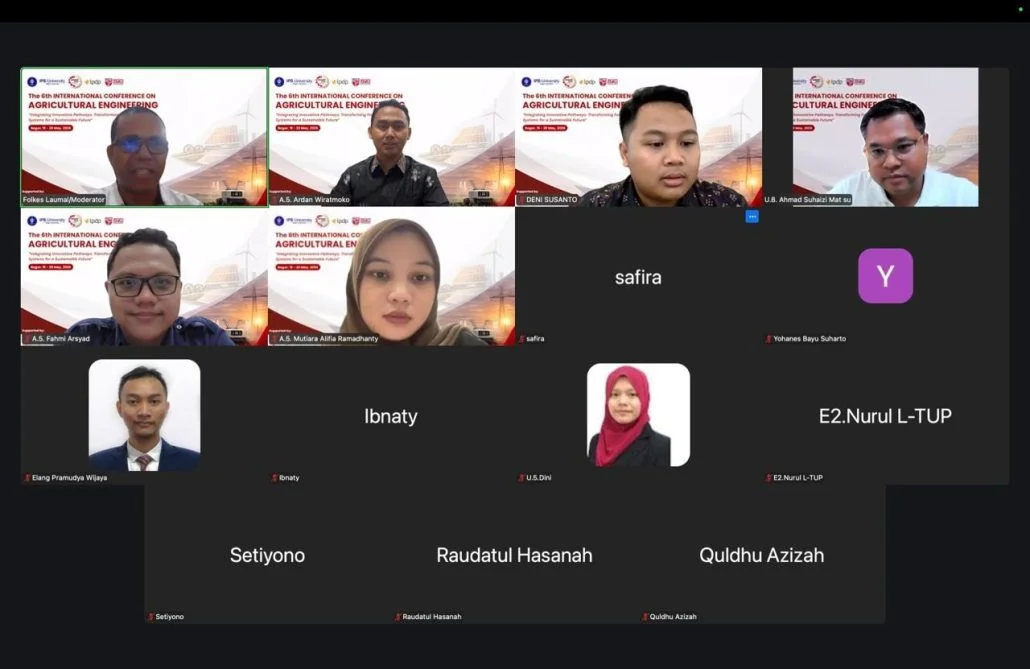
Yogyakarta, May 19-20, 2026. Researchers from the Smart Agriculture Research Center (Smartagri), Department of Agricultural Engineering and Biosystems (DTPB), Faculty of Agricultural Technology Universitas Gadjah Mada (FTP UGM), participated in The 6th International Conference on Agricultural Engineering for Sustainable Agricultural Production (AESAP) 2026, organized by the Faculty of Engineering and Technology at IPB University. This international conference was held online via Zoom Meeting and carried the theme "Integrating Innovative Pathways: Transforming Food and Energy Systems for a Sustainable Future". The event served as a scientific forum for researchers, academics, and practitioners to share innovations and research findings in the field of sustainable agricultural technology.
At this event, Smartagri DTPB FTP UGM presented three research teams with research topics focused on the development of precision agriculture, spectral sensing, artificial intelligence, and sustainable smart agricultural systems. The first research, titled "Multispectral-Based Monitoring of Papaya Photosynthetic Performance Using UAV-VTOL for Precision Agriculture Applications", was presented in Parallel Session 1: Agricultural Informatics and System Engineering on May 19, 2026. This research was conducted under the guidance of Andri Prima Nugroho, Ph.D., and highlighted the use of multispectral UAV-VTOL technology to support more efficient and data-driven monitoring of papaya plant physiological conditions. Through the integration of remote sensing technology and machine learning, this research is expected to support the development of an adaptive precision agriculture system responsive to plant needs and real-time field conditions.
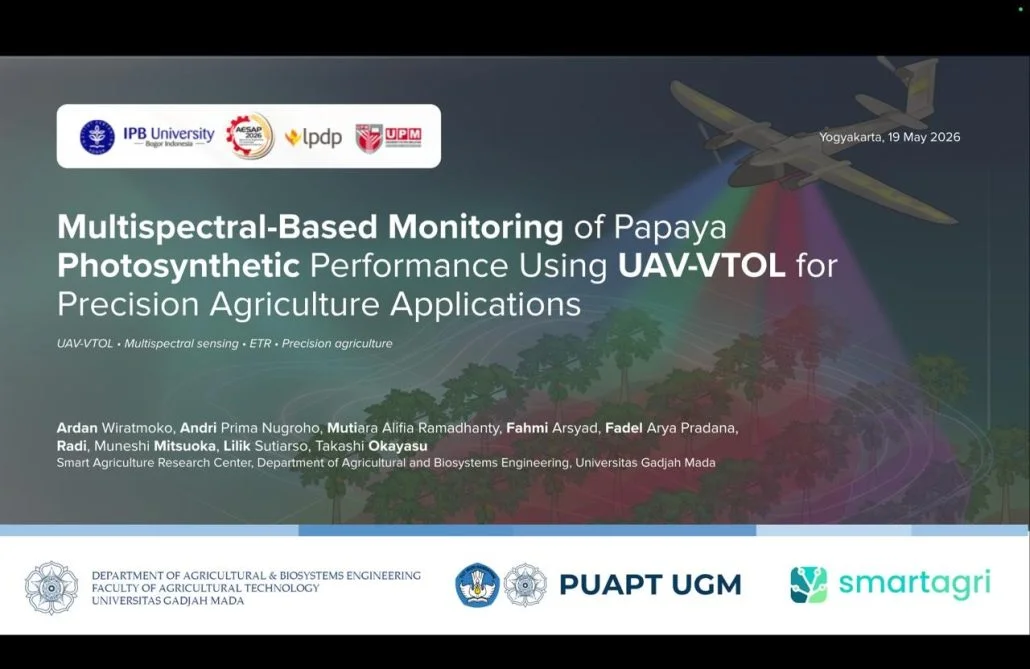
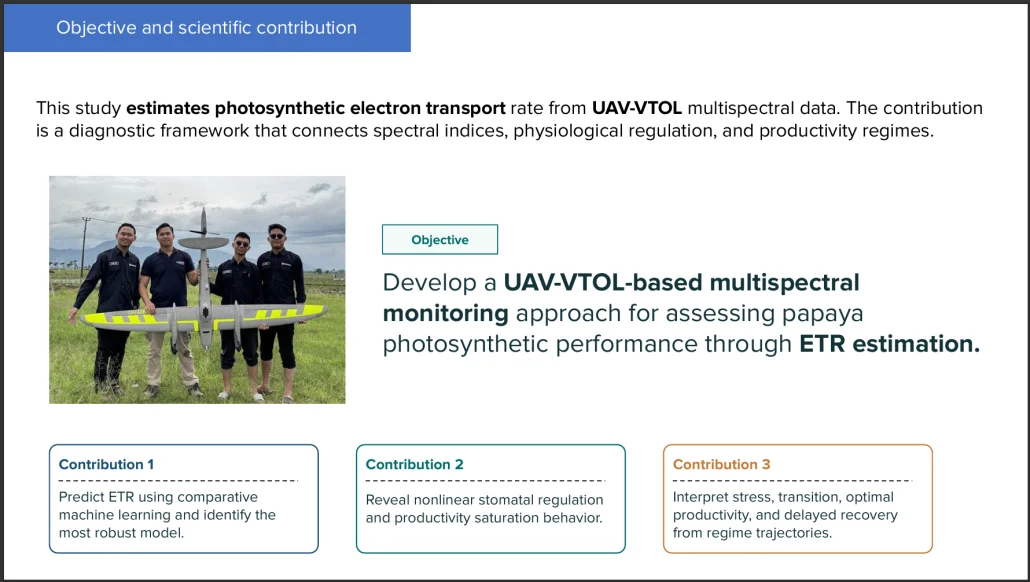
The research team for the first study consisted of Ardan Wiratmoko, M.Sc., Andri Prima Nugroho, Ph.D., Mutiara Alifia Ramadhanty, Fahmi Arsyad, S.T.P., Fadel Arya Pradana, S.Si., Dr. Radi, Assoc. Prof. Muneshi Mitsuoka, Prof. Lilik Sutiarso, and Prof. Takashi Okayasu. The research developed emphasized the use of multispectral data to support the analysis of photosynthetic performance in papaya plants as part of a smart technology-based plant health monitoring system. The development of this technology is expected to increase land management efficiency, support plant productivity, and strengthen the implementation of precision agriculture in the modern horticulture sector. Additionally, this research also contributed to the development of digital agricultural innovation that supports more effective and sustainable management of agricultural resources.
Meanwhile, the second research, titled "Growth and Spectral Response of Broccoli Microgreens under Living and Dead Microalgae Biofertilizer Treatments in a Controlled Plant Factory", was presented in Parallel Session 4: Agricultural Automation on May 20, 2026. This research was conducted under the guidance of Ardan Wiratmoko, M.Sc., and discussed the use of hyperspectral sensing and microalgae biofertilizer in a plant factory system to support non-destructive plant monitoring based on plant physiological response. The research focus was directed toward developing a more controlled and efficient plant production system capable of supporting the sustainability of modern agricultural systems through an approach combining automation technology and sensing.
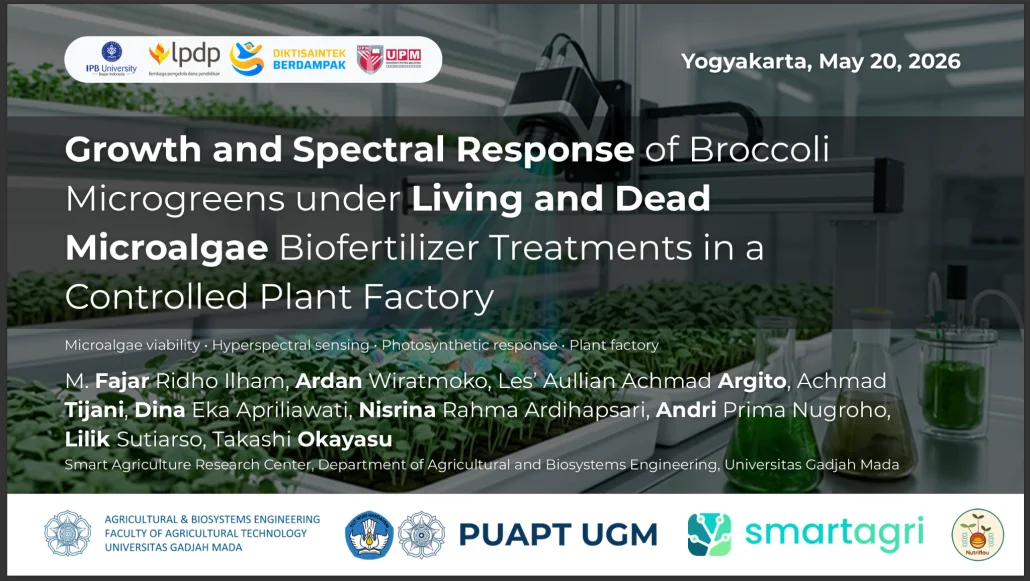
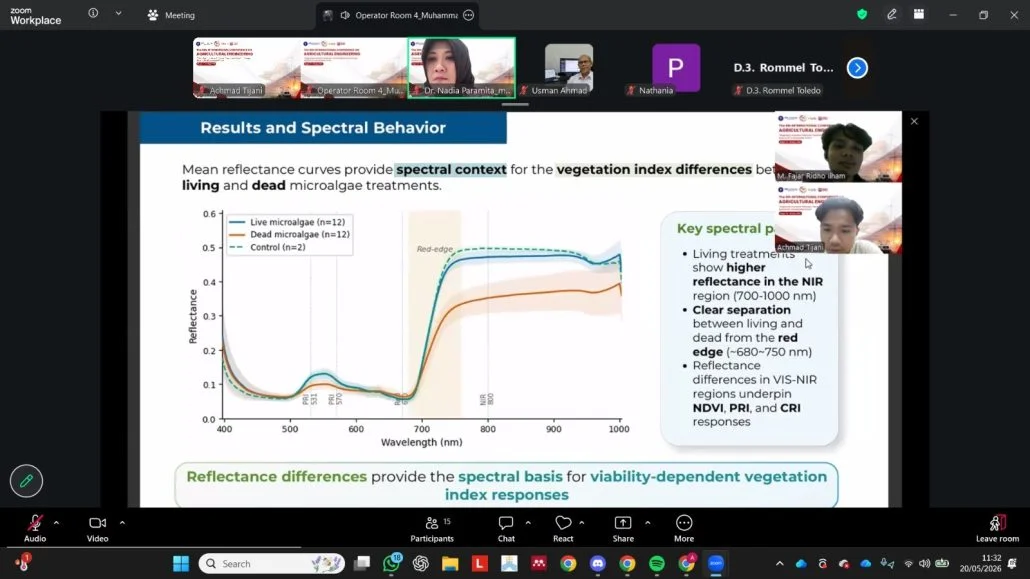
The research team for the second study consisted of M. Fajar Ridho Ilham, Ardan Wiratmoko, M.Sc., Les' Aullian Achmad Argito, Achmad Tijani, Dina Eka Apriliawati, Nisrina Rahma Ardihapsari, Andri Prima Nugroho, Ph.D., Prof. Lilik Sutiarso, and Prof. Takashi Okayasu. This research demonstrated how the integration of hyperspectral imaging technology and microalgae biofertilizer can be utilized to support a plant growth monitoring system in a controlled cultivation environment. The development of this research also showed the potential of smart farming and controlled environment agriculture technology in improving plant production quality while supporting efficiency in the use of agricultural inputs. Through this approach, the research is expected to contribute to the development of a more innovative and sustainable agricultural system for the future.
Additionally, Smartagri also presented research titled "Optimization of Excitation Voltage and Calibration Resistor for EIS-Based Chlorophyll Estimation in Lettuce (Lactuca sativa L.)", presented in Parallel Session 4: Agricultural Automation on May 20, 2026. This research was conducted under the guidance of Andri Prima Nugroho, Ph.D., and addressed the development of an electrical impedance spectroscopy (EIS)-based approach to support non-destructive plant chlorophyll estimation. This research also strengthened the development of sensor technology and smart technology-based plant monitoring systems to support the implementation of precision agriculture.
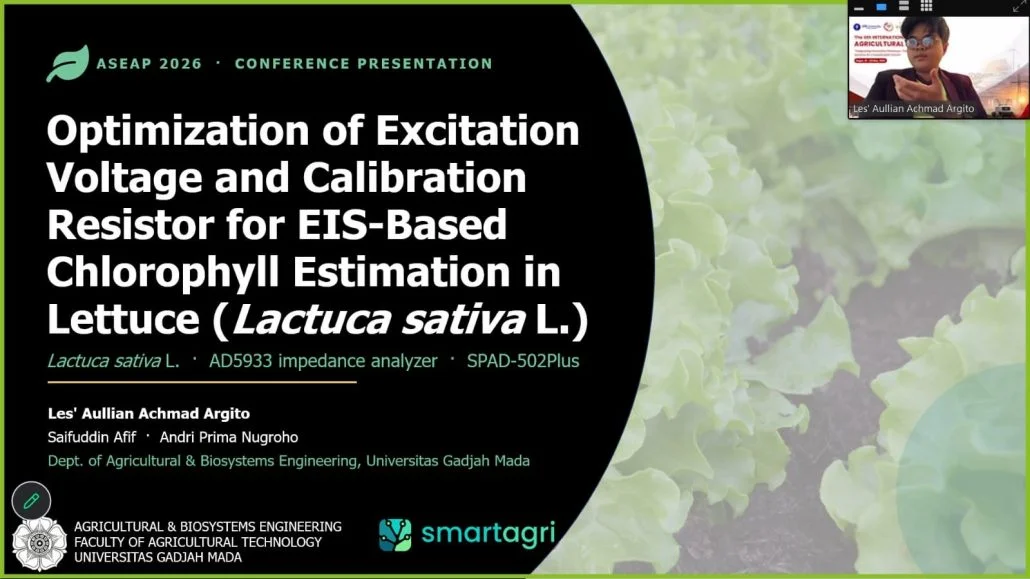
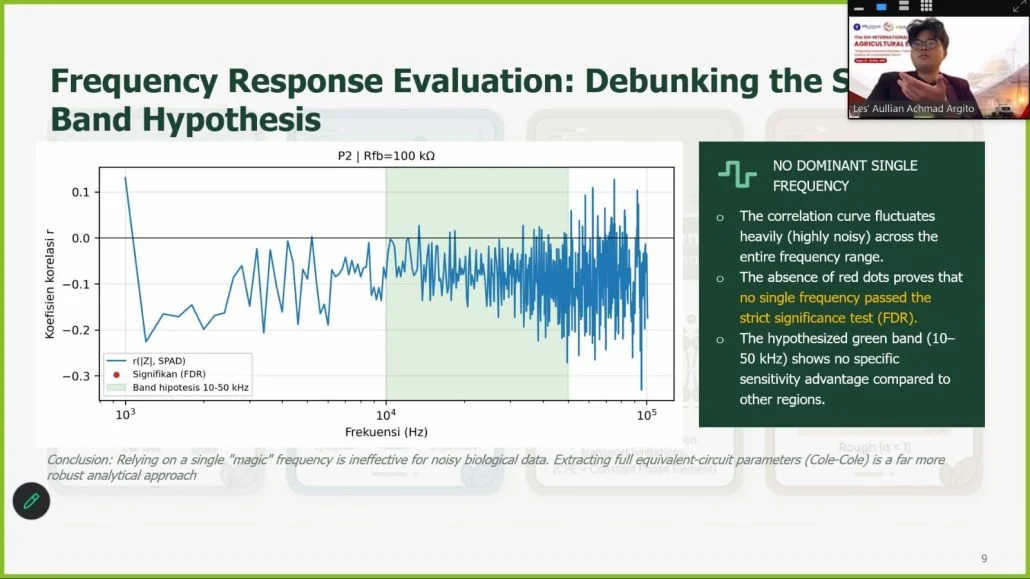
The research team for the third study consisted of Les' Aullian Achmad Argito, Saifuddin Afif, M.Sc., and Andri Prima Nugroho, Ph.D. The research developed focused on the optimization of measurement parameters to improve the quality and consistency of electrical impedance-based plant physiological analysis. Through the development of this technology, the research is expected to support the innovation of a more efficient, accurate, and applicable plant monitoring system in the development of smart agriculture technology.
The participation of Smartagri DTPB FTP UGM in AESAP 2026 demonstrates its commitment to developing smart agriculture-based agricultural technology research and innovation while strengthening international academic collaboration. This participation also represented an effort to support the development of a more precise, efficient, and sustainable agricultural system through the integration of sensing technology, automation, and agricultural data analysis. This activity aligns with the achievement of the Sustainable Development Goals (SDGs), particularly SDG 2 (Zero Hunger), SDG 9 (Industry, Innovation, and Infrastructure), SDG 12 (Responsible Consumption and Production), and SDG 13 (Climate Action), through the development of innovative technology that supports sustainable agricultural productivity and efficient resource management.
Originally published on our previous site. Read the original