
Public Lecture
Agricultural Engineering and Biosystems Lecturer at UGM, Dr. Andri Prima Nugroho Presents Development of Smart Agriculture Based on AI in UGM AI Seminar
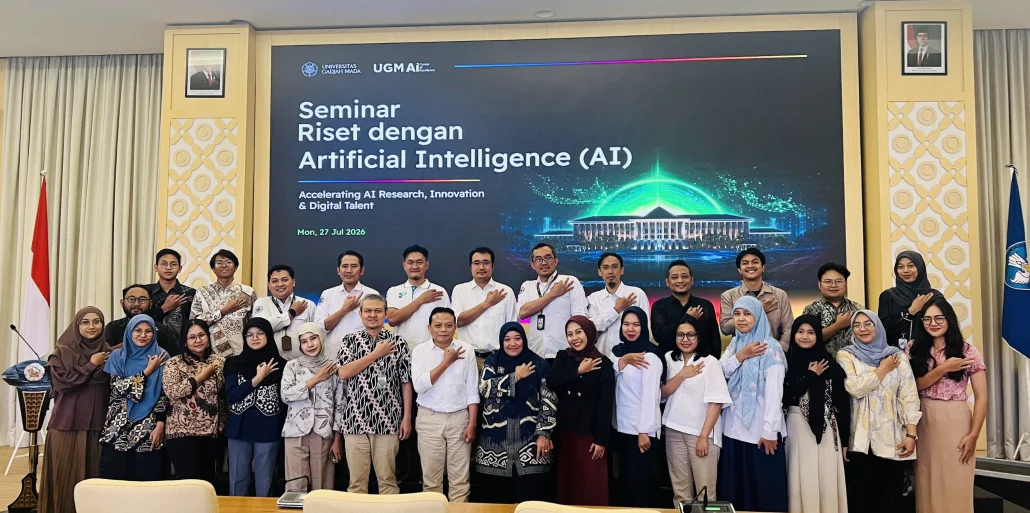
Yogyakarta, July 27, 2026 – Lecturer and researcher at the Department of Agricultural Engineering and Biosystems (DTPB), Faculty of Agricultural Technology, Universitas Gadjah Mada, Ir. Andri Prima Nugroho, S.T.P., M.Sc., Ph.D., IPU., ASEAN Eng., APEC Eng., was one of the speakers in the "UGM AI Seminar: Research with Artificial Intelligence (AI)" held on Monday, July 27, 2026, at Multimedia Room 1, UGM Central Office.
The seminar, initiated by the UGM AI Center of Excellence, served as a forum for disseminating experiences, research results, and the development of products and applications based on artificial intelligence from various disciplines within UGM. This activity was also part of the series of preparations toward the launch of the NVIDIA AI Technology Center (NVAITC) at Universitas Gadjah Mada.
The activity was divided into two main sessions: "Research Using AI" and "AI-Based Product Development." In the first session, speakers discussed the use of AI as a research method and supporting tool. Meanwhile, the second session presented the processes and results of developing AI-based technologies, products, and applications to address needs in various fields.
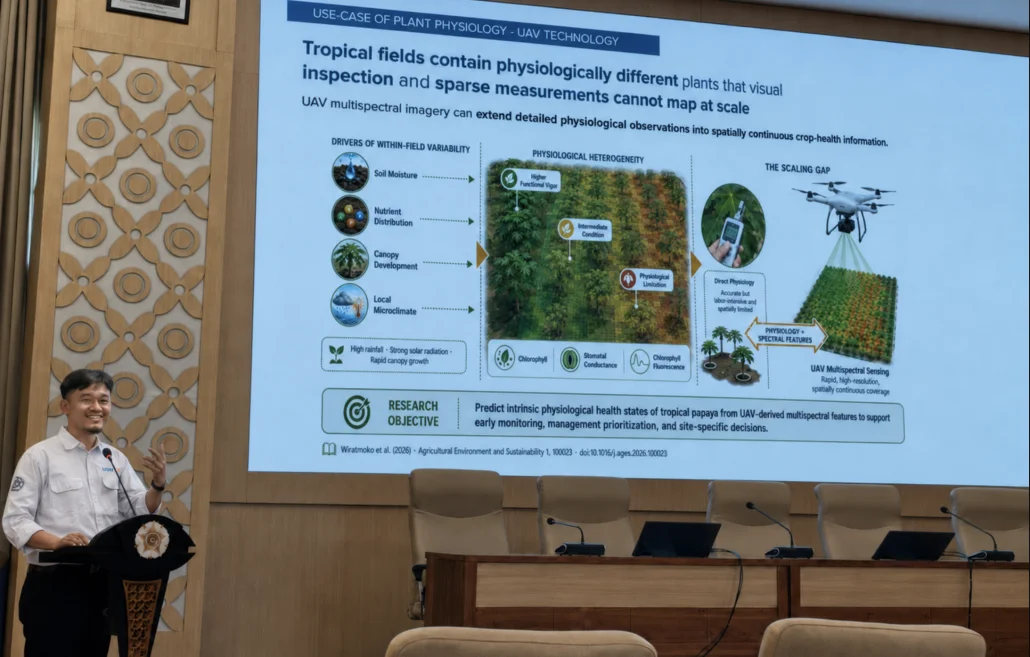
Andri Prima Nugroho was a speaker in the "AI-Based Product Development" session alongside dr. Dian Kesumapramudya Nurputra, M.Sc., Ph.D., Sp.A., Subsp.Neuro. and Dr. Nur Mohammad Farda, S.Si., M.Cs. The session was moderated by Dr. Muhammad Fakhrurrifqi.
In his presentation, Andri explained the development of artificial intelligence in agriculture through a smart agriculture approach. According to him, the application of AI in agriculture does not stop at the use of sensors, drones, or data presentation through dashboards. The primary value of AI lies in its ability to process various data sources into information, predictions, and recommendations that can assist in more accurate decision-making.
This approach becomes increasingly relevant because current agricultural practices face complex challenges, ranging from climate change, uncertainty of environmental conditions, limited resources, to demands for increased productivity while maintaining sustainability. Therefore, the development of smart agriculture requires integration between monitoring technology, data analysis, modeling, and decision-making systems.
Several examples of research and technology development conducted by the UGM Smart Agriculture team were also introduced at this seminar. These developments include monitoring of agricultural environments, assessment of plant conditions in open fields, utilization of drone imagery and plant physiology data, as well as data-driven controlled agricultural production systems. Various types of data can be integrated to help detect changes in plant and environmental conditions earlier.
Andri emphasized that the development of AI technology for agriculture must be carried out contextually. The models developed must consider commodity characteristics, tropical agroecosystem conditions, farm scales, and the needs of field users. Validation through direct observation and measurement is also still necessary to ensure that the recommendations generated are truly scientifically accountable.
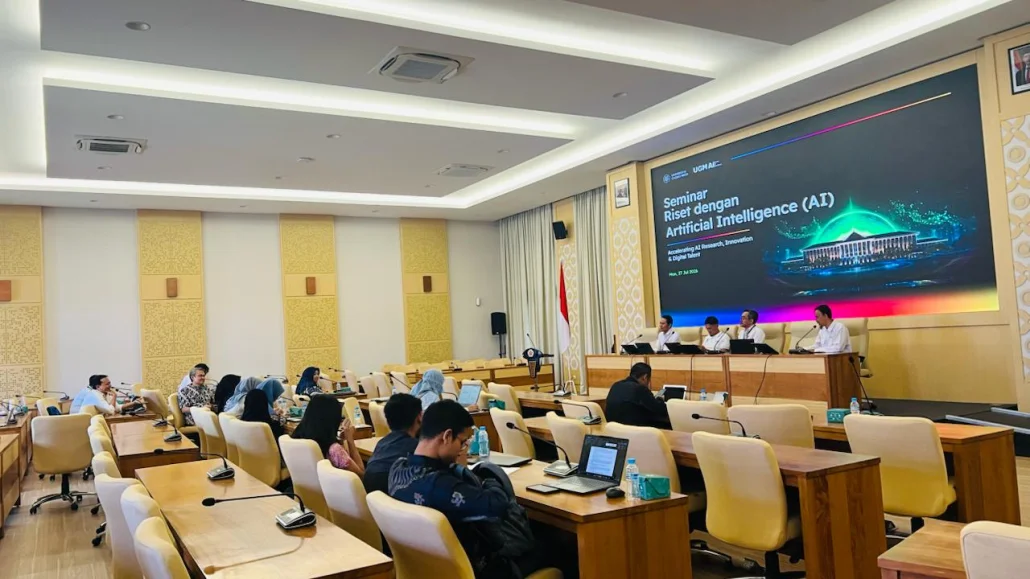
The seminar proceeded interactively through discussion and question-and-answer sessions. The discussion not only addressed technical aspects of AI model development but also implementation challenges in the field, the need for representative data, validation processes, and the importance of collaboration among researchers, technology developers, government, industry, students, and end users.
The participation of DTPB FTP UGM faculty in this activity demonstrates the role of Agricultural Engineering and Biosystems in developing AI oriented toward solving real-world problems. The integration of agricultural science, biosystems, instrumentation, remote sensing, and artificial intelligence is expected to drive the emergence of more adaptive, precise, and sustainable agricultural technologies.
Through the UGM AI Seminar, Universitas Gadjah Mada continues to strengthen the ecosystem of multidisciplinary AI research and innovation. This forum is expected to serve as a space for knowledge exchange while opening opportunities for new collaborations to develop AI products and applications that have real impact for society.
This activity contributes to the achievement of the Sustainable Development Goals (SDGs), particularly SDG 2: Zero Hunger, SDG 4: Quality Education, SDG 9: Industry, Innovation, and Infrastructure, SDG 13: Climate Action, and SDG 17: Partnerships for the Goals.
Originally published on our previous site. Read the original