
Uncategorized
SmartAgri Researcher and DTPB UGM Lecturer Speaks at BRIN Webinar on AI and IoT in Smart Farming
YOGYAKARTA, August 24, 2026 – Ir. Andri Prima Nugroho, S.T.P., M.Sc., Ph.D, IPU., ASEAN Eng., APEC Eng., researcher at the Smart Agriculture Research Center UGM and lecturer in the Department of Agricultural Engineering and Biosystems (DTPB), Faculty of Agricultural Technology at Universitas Gadjah Mada, was one of the speakers at Webinar Smart Mechatronics Research Center (PRMC) #1 held by the National Research and Innovation Agency (BRIN) on Monday, August 24, 2026.
The webinar, themed "The Role of Artificial Intelligence (AI) and Internet of Things (IoT) in Smart Farming," was organized by the Smart Mechatronics Research Center, Electronics and Informatics Research Organization of BRIN. The event was opened by Prof. Yanuandri Putrasari, M.Eng., Ph.D., Head of the Smart Mechatronics Research Center BRIN, and was moderated by Triya Haiyunnisa, M.T., researcher at the Smart Mechatronics Research Center BRIN.
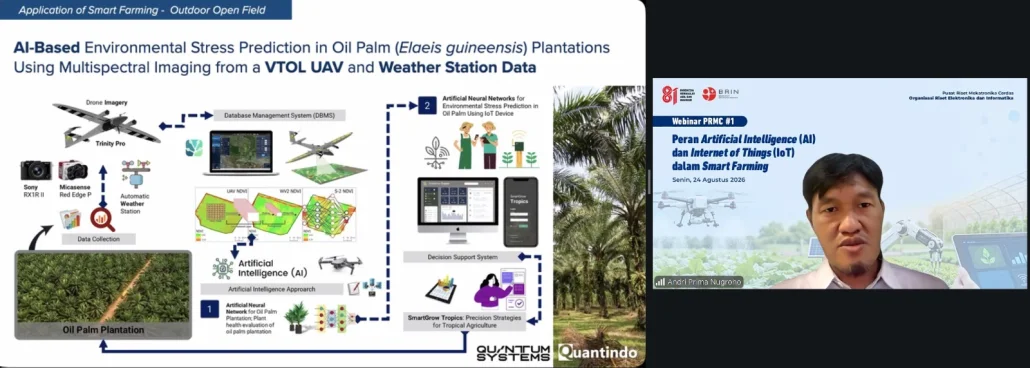
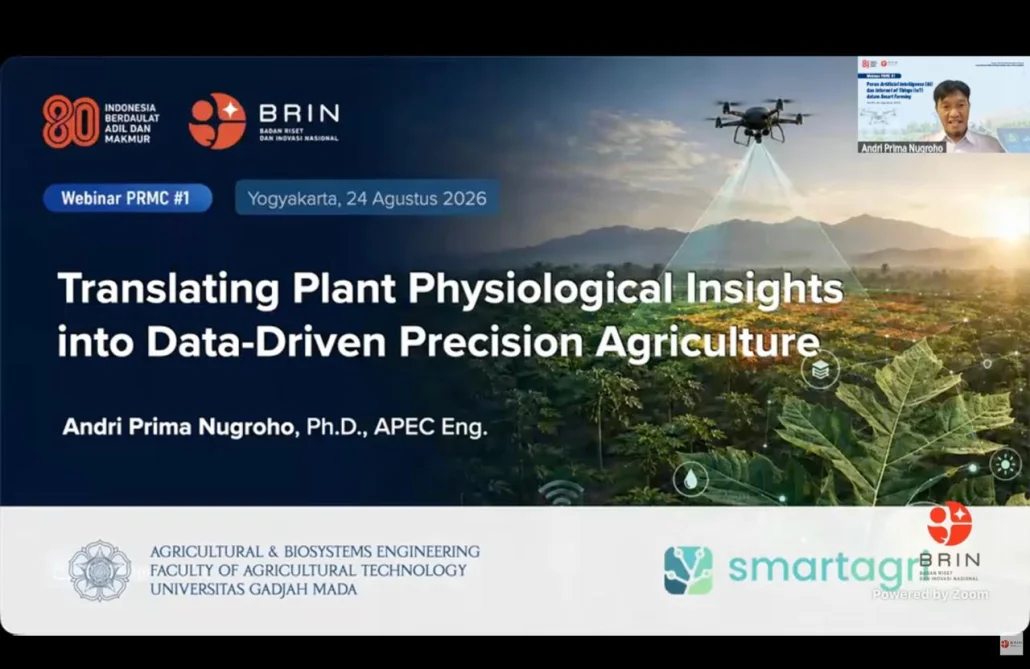
At the event, Dr. Andri presented material titled "Translating Plant Physiological Insights into Smart Farming Decisions: An AI- and IoT-Enabled Precision Agriculture Approach." The material discussed how plant physiological information can be integrated with sensor technology, Internet of Things (IoT), and artificial intelligence to produce relevant information for decision-making in precision agriculture systems.
Dr. Andri emphasized that the development of smart farming is not only related to the ability to collect data through sensors. An equally important stage is how data on plant and environmental conditions can be analyzed, interpreted, and used as a basis for more appropriate cultivation decision-making.
This approach is aligned with various research and development activities at the Smart Agriculture Research Center UGM, particularly in the integration of agricultural sensors, IoT, plant condition monitoring, remote sensing, data analysis, and decision support systems to achieve more precise, efficient, and sustainable agriculture.
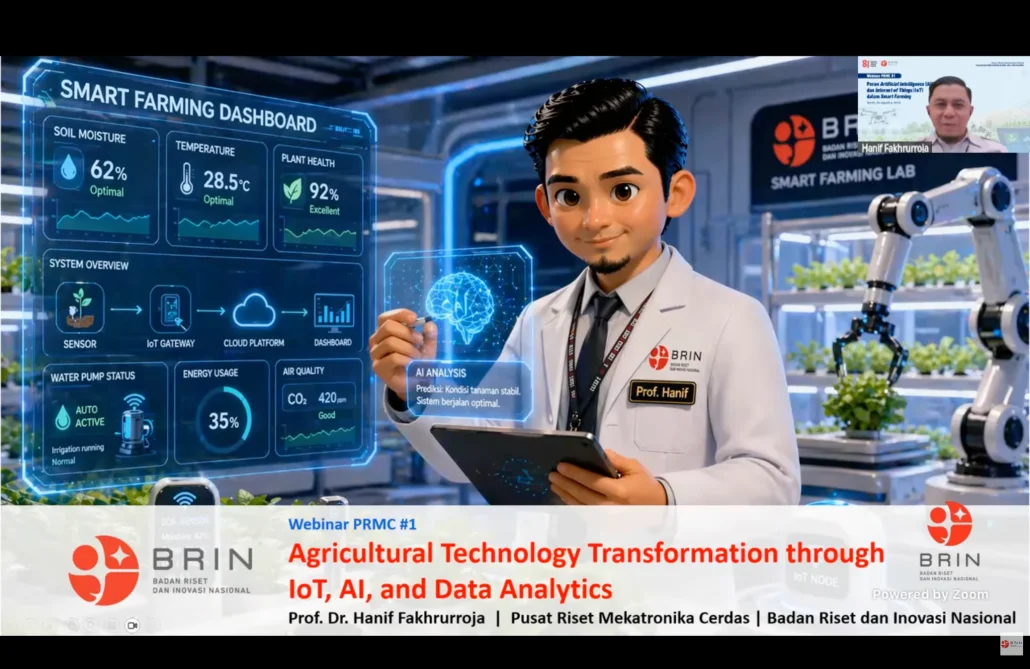
The webinar also featured Prof. Dr. Hanif Fakhrurroja, researcher at the Smart Mechatronics Research Center BRIN, who presented material titled "Transformation of Agricultural Technology through IoT, AI, and Data Analytics." The material expanded the discussion on the use of digital technology and data analytics as part of the transformation of agricultural production systems.
Meanwhile, Dr. Muhtadan, researcher at the Smart Mechatronics Research Center BRIN, raised the theme "Towards Agentic AI on Edge Devices: From Computer Vision Perception to Autonomous Decision-Making for Industrial Smart Farming." This discussion demonstrated the development of smart farming towards systems that are not only capable of observation, but also increasingly intelligent in processing information and supporting autonomous decision-making.
The combination of the three presentations illustrated the trajectory of smart farming development that is increasingly integrated, ranging from understanding plant biological conditions, data collection through sensors and IoT, data processing using AI and data analytics, to the development of intelligent systems capable of supporting faster and more adaptive decision-making.
For Dr. Andri, technology integration must still be grounded in the biological needs of plants and real-world challenges in the field. Sensor technology, AI, and IoT become valuable when they are able to produce information that can be used to improve input use efficiency, understand plant responses, and support cultivation decisions more precisely.
This PRMC #1 webinar also served as a space for knowledge exchange between UGM and BRIN in the development of future agricultural technology. Collaboration between higher education institutions and national research agencies is important for connecting agricultural science with advances in mechatronics, artificial intelligence, IoT, and digital technology so that innovations developed can be increasingly relevant to the needs of Indonesia's agricultural sector.
This activity also supported the achievement of the Sustainable Development Goals (SDGs), particularly SDG 2: Zero Hunger through the development of technology to increase agricultural productivity; SDG 9: Industry, Innovation, and Infrastructure through the utilization of AI, IoT, edge computing, and precision agriculture; SDG 12: Responsible Consumption and Production through improved efficiency of resource use; SDG 13: Climate Action through the development of more adaptive agricultural systems; and SDG 17: Partnerships for the Goals through strengthening collaboration between higher education institutions and national research agencies.
Originally published on our previous site. Read the original