SmartAgri UGM Participates in NVAITC Follow-up Meeting, Discusses Progress of AI Research for Agriculture
 Smart Agriculture Research Center
 Collaboration Research
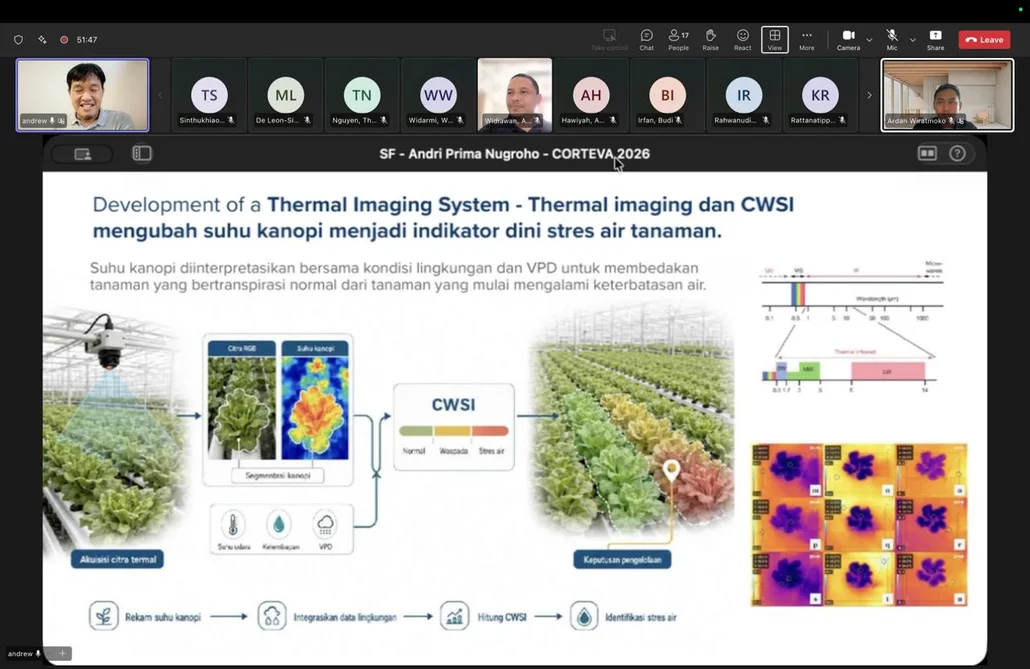
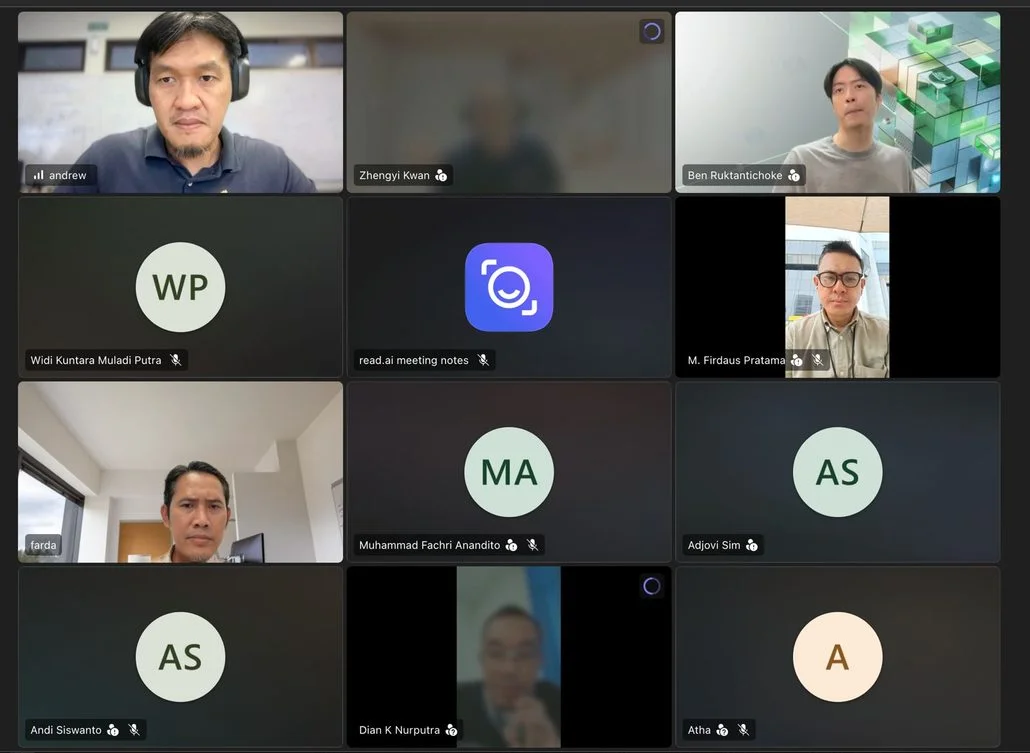
Yogyakarta, October 29, 2026: Smart Agriculture Research Center (SmartAgri) UGM participated in a follow-up meeting under the UGM Indosat NVIDIA AI Technology Center (NVAITC) program to discuss the development of artificial intelligence (AI) research in agriculture. In this agenda, SmartAgri was represented by Ir. Andri Prima Nugroho, S.T.P., M.Sc., Ph.D., IPU., ASEAN Eng., APEC Eng., Widi Kuntara Muladi Putra, S.T., and Muhammad Athala Fawwaz Dzaky, S.T.P.. This follow-up meeting is a continuation of the launch of the UGM Indosat NVIDIA AI Technology Center at the UGM Innovation and Creativity Building (GIK) on Thursday (13/8/2026). The technology center is being developed through a collaboration between UGM, Indosat Ooredoo Hutchison, NVIDIA, and the government to strengthen talent, research, infrastructure, and AI implementation in Indonesia. As part of its launch series, SmartAgri UGM introduced research on Smart Peilschaal, a technology for reading irrigation water surface elevation based on image processing.
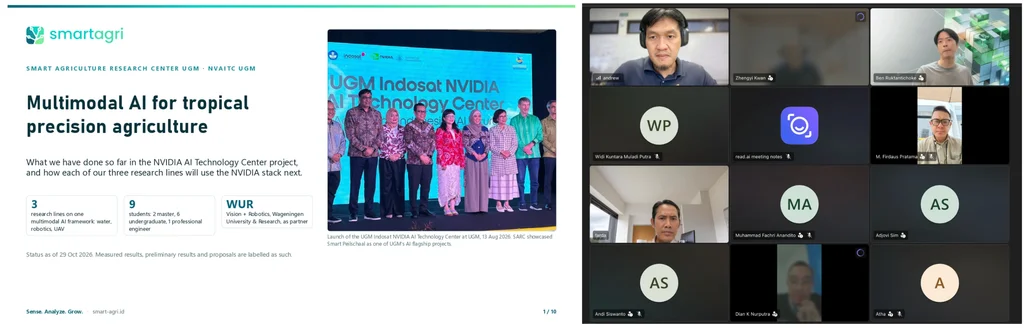
SmartAgri UGM, located within the Department of Agricultural and Biosystems Engineering, Faculty of Agricultural Technology UGM, is developing various AI applications to support agricultural monitoring and management. This team is coordinated by Ir. Andri Prima Nugroho. Through the NVAITC follow-up, the team seeks to connect agricultural research needs with technical expertise and computing infrastructure available in the collaborative ecosystem.
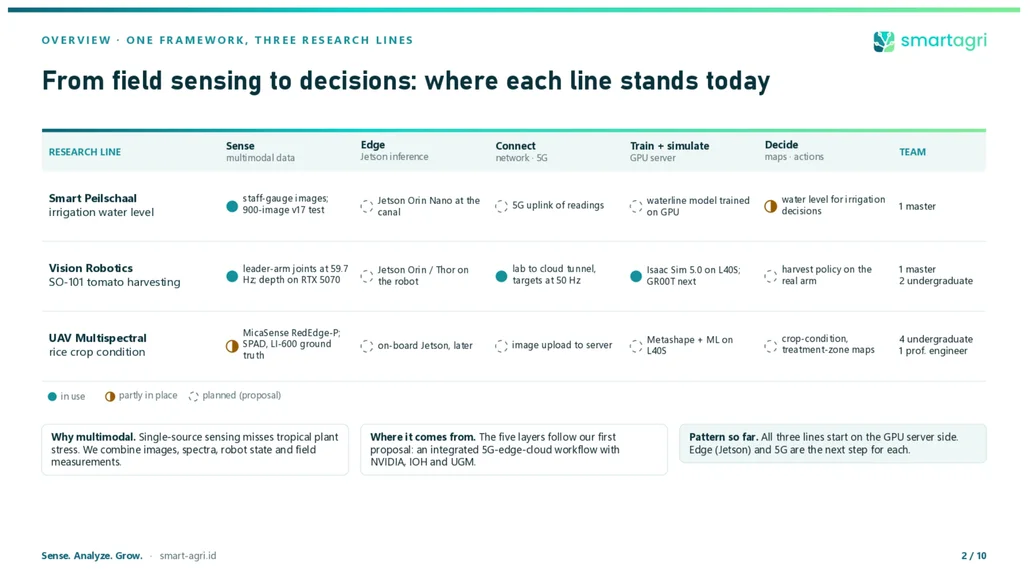
Based on progress updates as of October 29, 2026, SmartAgri presented three research tracks currently under development: irrigation water surface elevation monitoring through Smart Peilschaal, robotics for tomato harvesting, and rice plant condition analysis using multispectral imagery from UAVs. All three leverage field data to generate information that can support decision-making, though they are at different stages of development.
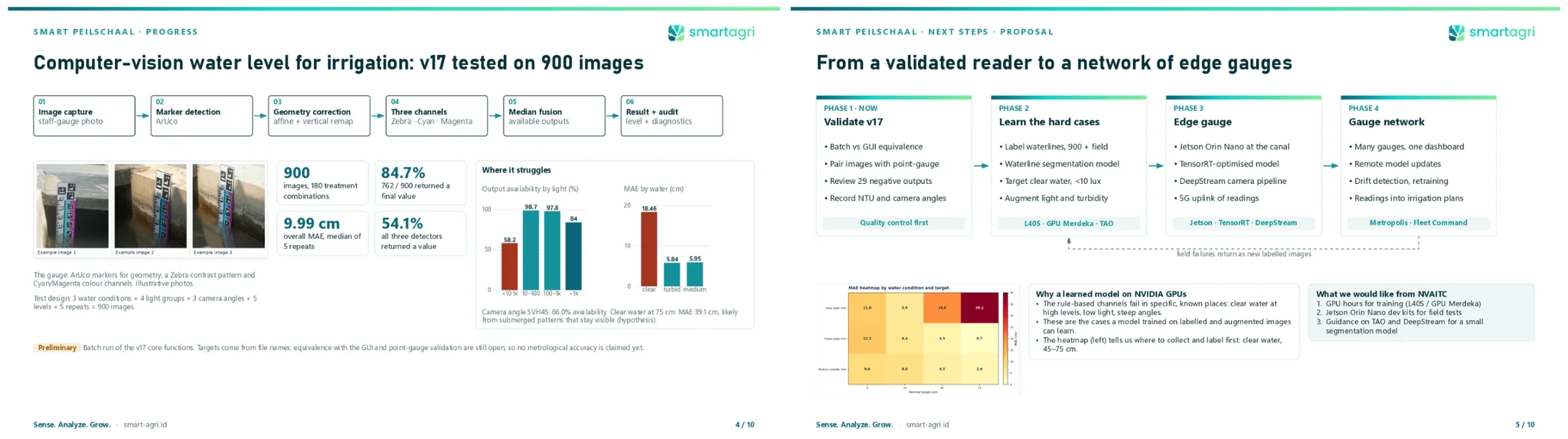
On the irrigation monitoring track, the team has tested an initial version of the Smart Peilschaal system using 900 images with varying water conditions, lighting, camera angles, and water surface elevations. The system produced readings for 762 images, or 84.7 percent of the entire test dataset. These results are still preliminary: the team needs to compare the system's readings with direct field measurements before concluding the tool's accuracy level for operational use.
One focus of future development is to address conditions that still challenge the reading process, such as clear water at certain heights, dim lighting, and steep camera angles. The team plans to prepare labeled data to train a water line boundary recognition model, then test the possibility of its implementation on computing devices near irrigation channels. For this stage, SmartAgri has identified needs for GPU computing time, development equipment for field trials, and technical support.
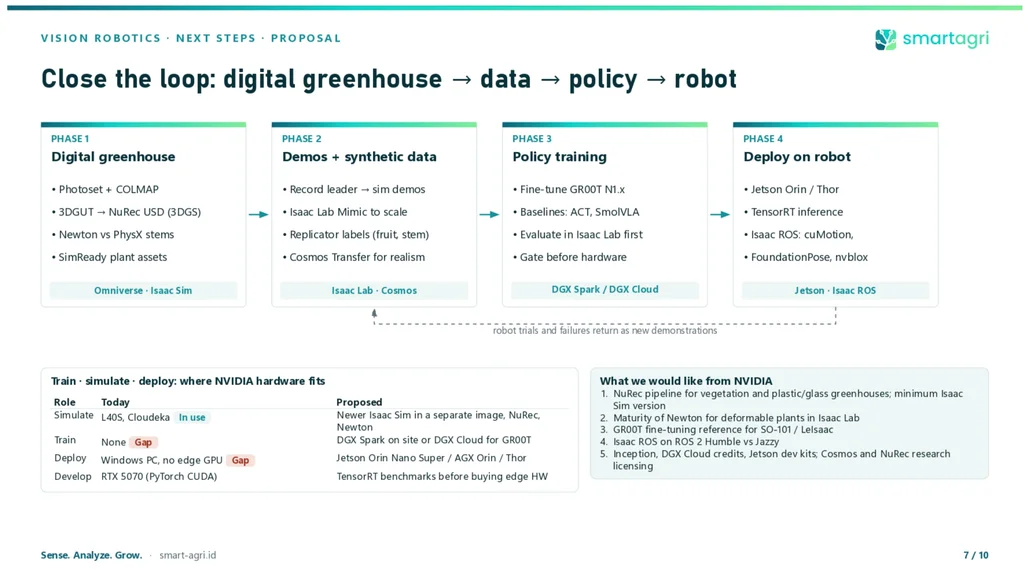
On the robotics track, the team is developing a simulation of the SO-101 robot arm for tomato harvesting research using Isaac Sim and Isaac Lab. Progress updates show that the physical robot arm's movements have been used to control the virtual robot arm through a cloud computing system. The next stage includes developing a greenhouse simulation environment, collecting robot movement samples, and testing the model before applying it to the physical robot.
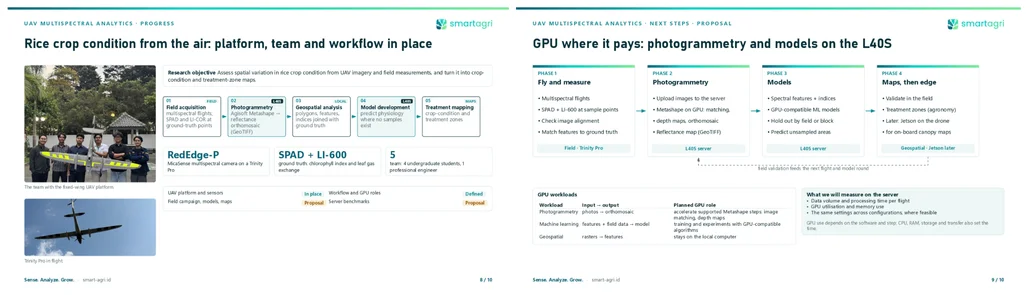
The third research track focuses on rice plant condition analysis using multispectral UAV imagery combined with direct field measurements. SmartAgri has prepared the platform, sensors, team, and research workflow. Field data collection, model development, and creation of plant condition maps remain planned stages. Going forward, the team wishes to test GPU utilization to accelerate parts of the image processing and model development workflow.
In addition to the three research tracks detailed in the progress update materials, the team is also preparing discussion on Agentic AI for the follow-up meeting. Achievements and support needs on this topic will be further clarified in the next update.
Through the scheduled follow-up meeting, SmartAgri hopes to present research progress in a measurable way, discuss technical challenges, and determine the most relevant form of support. The discussion results are expected to help the team continue technology testing until it can address real needs in irrigation, agricultural robotics, and plant monitoring.
Collaboration within NVAITC presents an opportunity for SmartAgri UGM to bring together expertise in agriculture with AI development and computing infrastructure. Through phased testing and interdisciplinary collaboration, the technologies being developed are expected to support more precise, efficient agricultural management that aligns with field conditions.
Connection to SDGs
- SDG 2 – Zero Hunger, through the development of technology aimed at supporting plant monitoring and agricultural production management.
- SDG 6 – Clean Water and Sanitation, through research on water surface elevation monitoring to support irrigation management.
- SDG 9 – Industry, Innovation, and Infrastructure, through the development of AI research, robotics, and utilization of computing infrastructure.
- SDG 17 – Partnerships for the Goals, through collaboration among universities, industry, technology providers, and government.
Written bySmart Agriculture Research CenterOriginally published on our previous site. Read the original