
Publication
Research Publication: Analysis of VPD Dynamics to Support Precision Irrigation in Open Paddy Fields
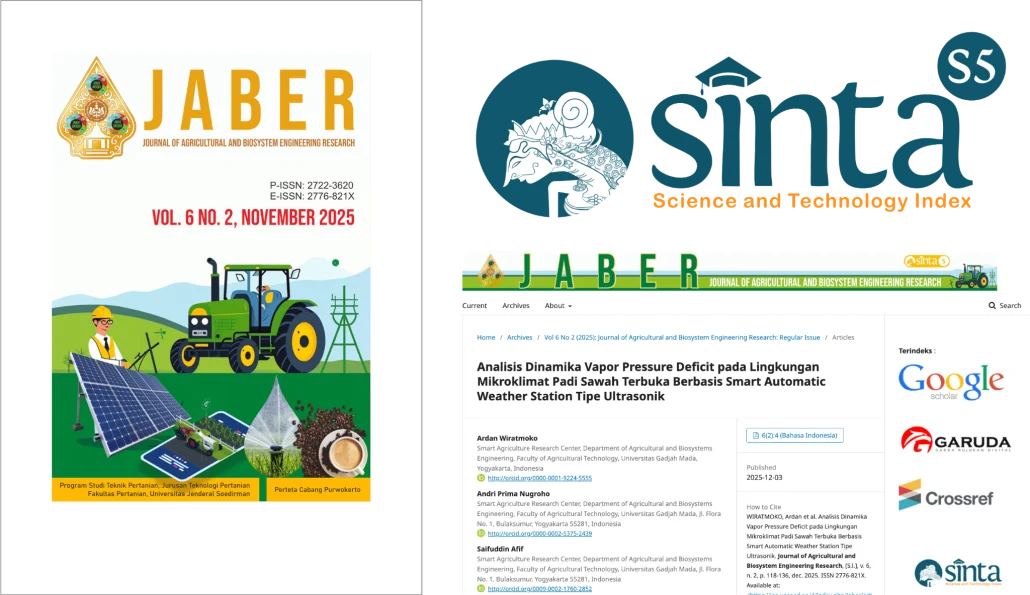
Yogyakarta, December 3, 2025 – Smart Agriculture Research Center Universitas Gadjah Mada has produced another research publication in the Journal of Agricultural and Biosystem Engineering Research (JABER). This research analyzes the dynamics of Vapor Pressure Deficit (VPD) in the microclimate environment of open paddy fields using a Smart Automatic Weather Station (AWS) of ultrasonic type.
The cultivation of open paddy fields is strongly influenced by microclimate conditions, such as air temperature, relative humidity, solar radiation, wind, and rainfall. Changes in these conditions can affect plant transpiration processes, energy-water balance in the canopy, and plant water requirements. Therefore, microclimate monitoring becomes important to support data-based precision irrigation systems.
One important indicator in understanding the relationship between plants and the atmosphere is Vapor Pressure Deficit (VPD). Simply put, VPD describes how much "pulling force" the atmosphere exerts on water vapor from the plant. When VPD is high, plants tend to lose more water through transpiration. Conversely, when VPD is low, the atmosphere is more humid and the pressure for water loss from the plant becomes smaller.
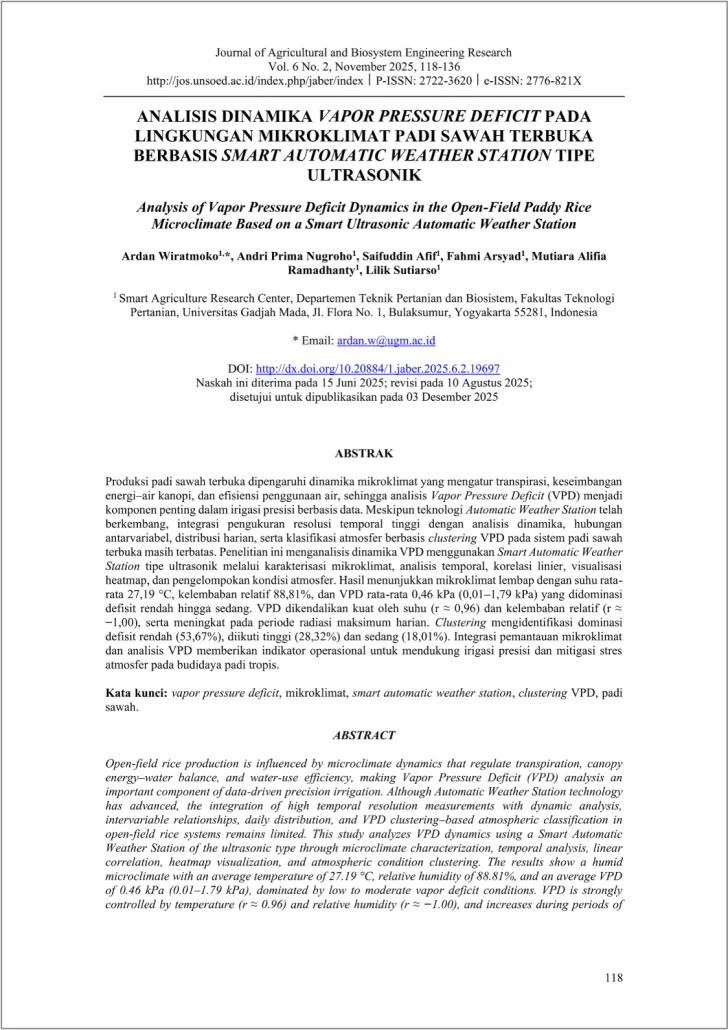
The research titled "Analysis of Vapor Pressure Deficit Dynamics in the Microclimate Environment of Open Paddy Fields Based on Smart Automatic Weather Station of Ultrasonic Type" was conducted by Ardan Wiratmoko, Andri Prima Nugroho, Saifuddin Afif, Fahmi Arsyad, Mutiara Alifia Ramadhanty, and Lilik Sutiarso. The article has been published in Journal of Agricultural and Biosystem Engineering Research Volume 6 Number 2 Year 2025 on pages 118–136.
The research was conducted on open paddy fields around Balai Penyuluhan Pertanian Wates, Kulon Progo Regency, Special Region of Yogyakarta. Microclimate observations were conducted during December 3–11, 2024 using a Smart Automatic Weather Station of ultrasonic type capable of automatically and periodically recording environmental data.
The AWS system used recorded various microclimate parameters, such as air temperature, relative humidity, air pressure, wind speed, wind direction, rainfall, and solar light intensity. Data were recorded at 10-minute intervals, thus providing a more detailed picture of microclimate changes throughout the day.
Simply put, this research not only examined weather conditions in general, but also analyzed how temperature and humidity shape VPD values over time. The collected data were then analyzed using a Python-based computational approach, including statistical analysis, correlation analysis, heatmap visualization, and VPD clustering to group atmospheric conditions into operational categories.
The research results showed that the environment of open paddy fields during the observation period had relatively humid microclimate conditions. The average air temperature was recorded at 27.19 °C, average relative humidity was 88.81%, and average VPD value was 0.46 kPa with a range of 0.01–1.79 kPa. This value indicates that the atmospheric conditions were dominated by low to moderate vapor pressure deficits.
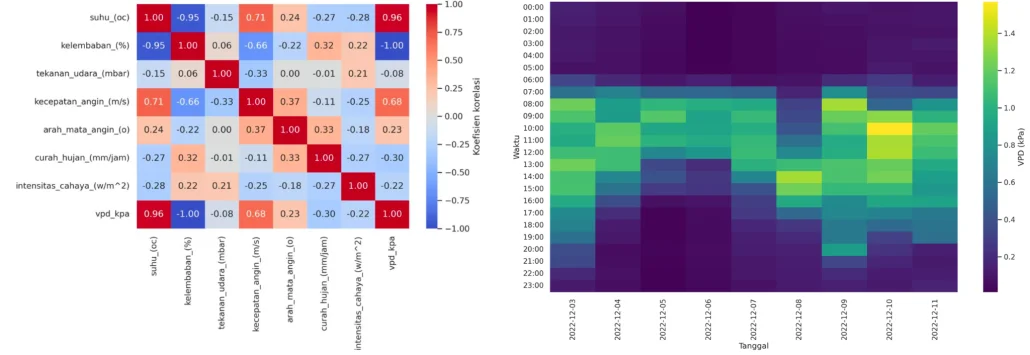
Correlation analysis showed that VPD was strongly influenced by air temperature and relative humidity. VPD had a very strong positive correlation with air temperature, approximately r ≈ 0.96, and a very strong negative correlation with relative humidity, approximately r ≈ −1.00. This indicates that VPD increases when temperature rises and humidity decreases, particularly during the daytime period when solar radiation reaches its peak.
Daily visualization showed that VPD values tended to be low from night to early morning, when air temperature was lower and humidity approached saturation. Conversely, VPD increased from morning to afternoon, particularly around the period 08.00–14.00 WIB, when air temperature increased and relative humidity decreased. This period is important because it is potentially related to increased plant water requirements.
Through the clustering approach, VPD conditions were grouped into three categories, namely low vapor deficit, moderate vapor deficit, and high vapor deficit. Clustering results showed that low vapor deficit conditions were dominant with a percentage of 53.67%, followed by high vapor deficit at 28.32%, and moderate vapor deficit at 18.01%. This result indicates that although the paddy environment tends to be humid, there remain periods with high atmospheric pressure that need to be considered in water management.
Collaboration and Support:
This research was conducted by a team from Smart Agriculture Research Center, Department of Agricultural Engineering and Biosystems, Faculty of Agricultural Technology, Universitas Gadjah Mada. Collaboration within this team brought together expertise in the fields of precision agriculture, agricultural microclimate, sensor systems, automatic weather stations, data analysis, and irrigation water management.
Through this collaboration, the research not only focused on weather measurement, but also connected microclimate data with practical needs in open paddy field cultivation. This approach is important because information on temperature, humidity, radiation, and VPD can be used as a basis for understanding periods of critical plant water requirements in a more objective manner.
The research team expresses gratitude to PUAPT UGM (Center of Excellence for Inter-University Collaboration Universitas Gadjah Mada) for the facility support so that this research could be implemented. The research team also expresses appreciation to the Smart Agriculture Research Center, Department of Agricultural Engineering and Biosystems, Faculty of Agricultural Technology, Universitas Gadjah Mada, for technical assistance and support throughout the system development, research implementation, data collection, and analysis stages.
Benefits and Impact:
This research provides important contribution to the development of data-based microclimate monitoring systems in open paddy field cultivation. By understanding VPD dynamics, farmers, researchers, and irrigation managers can obtain better information regarding periods when plants are likely to experience increased water requirements.
VPD information can help support precision irrigation, particularly in determining when atmospheric conditions drive plants to lose more water through transpiration. Thus, water management can be directed to be more responsive to actual environmental conditions, rather than based only on fixed schedules.
This approach is also beneficial for supporting mitigation of atmospheric stress on rice plants. When the system detects periods of high VPD, land managers can be more alert to the possibility of increased water requirements, especially during growth phases that are sensitive to water shortage.
From the Sustainable Development Goals (SDGs) perspective, this research supports SDG 2: Zero Hunger because it contributes to the development of technology to support productivity and resilience of rice production systems. This research is also aligned with SDG 6: Clean Water and Sanitation through the potential for more efficient irrigation water management. Additionally, the use of Smart Automatic Weather Station, microclimate sensors, data analysis, and VPD clustering supports SDG 9: Industry, Innovation, and Infrastructure through the development of smart agricultural technology innovation. In the long term, this technology also supports SDG 12: Responsible Consumption and Production and SDG 13: Climate Action, because it helps promote rice cultivation that is more adaptive to climate dynamics and more efficient in water resource use.
In the future, this approach has the potential to be further developed with the integration of Internet of Things (IoT), microclimate monitoring dashboard, high VPD early warning system, and data-based irrigation recommendations. This integration can strengthen the implementation of smart farming in open paddy field cultivation, particularly in addressing climate change and daily weather variability.
The full publication of this research can be accessed through the following DOI link: http://dx.doi.org/10.20884/1.jaber.2025.6.2.19697
Contact: Ardan Wiratmoko, S.T.P., M.Sc. ardan.w@ugm.ac.id
Originally published on our previous site. Read the original