
Publication
Research Publication: Evaluation of Commercial Fertilizer Quality to Support the Sustainability of Indonesia's Oil Palm Plantations
Yogyakarta, 5 September 2024 – Smart Agriculture Research Center Universitas Gadjah Mada has produced another research publication in the Journal of Oil Palm Research. This research conducted a comprehensive evaluation of the composition and nutrient content of various commercial fertilizers used in oil palm plantations in Indonesia.
Fertilizer is one of the important inputs in oil palm cultivation. The selection of appropriate fertilizer directly affects plant growth, fresh fruit bunch productivity, product quality, and soil sustainability. However, challenges are still found in the field, including fertilizers that do not meet specifications, fertilizers mixed with other materials, and counterfeit fertilizers. This condition can harm farmers and plantation managers because fertilization costs are substantial, but the nutrient content received by plants does not match plant requirements.
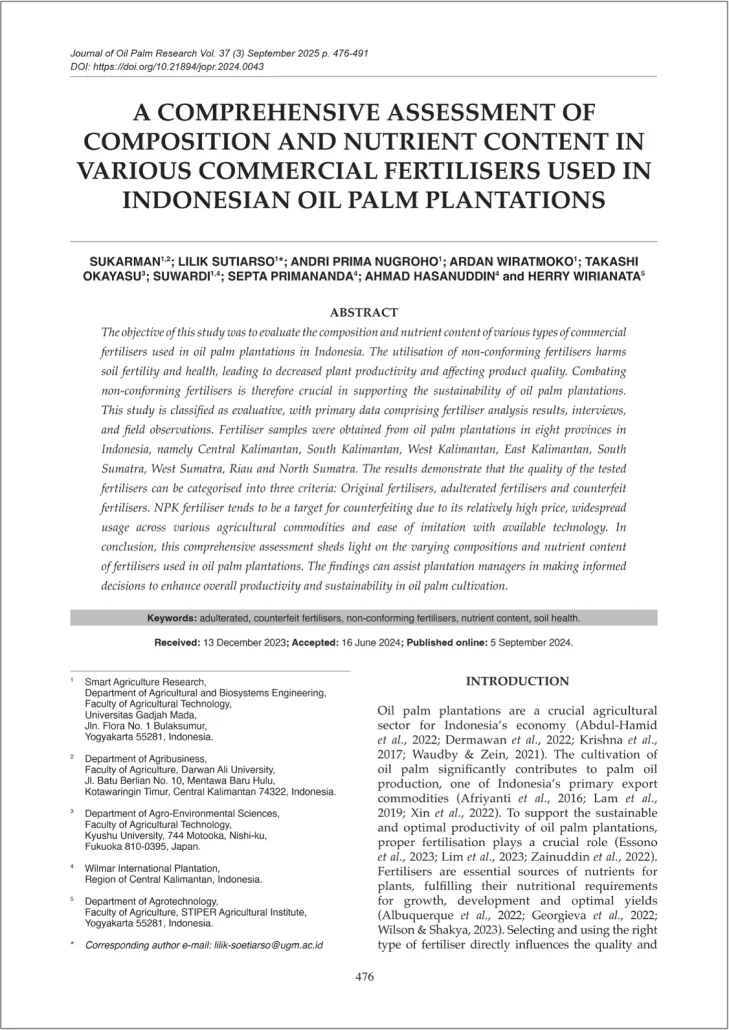
This research, titled "A Comprehensive Assessment of Composition and Nutrient Content in Various Commercial Fertilisers Used in Indonesian Oil Palm Plantations", was conducted by Sukarman, Lilik Sutiarso, Andri Prima Nugroho, Ardan Wiratmoko, Takashi Okayasu, Suwardi, Septa Primananda, Ahmad Hasanuddin, and Herry Wirianata. The article has been published in Journal of Oil Palm Research Volume 37 Number 3 Year 2025 on pages 476–491.
This research was conducted by analyzing fertilizer samples from various oil palm plantations in eight provinces in Indonesia, namely Central Kalimantan, South Kalimantan, West Kalimantan, East Kalimantan, South Sumatra, West Sumatra, Riau, and North Sumatra. Data collection was conducted through laboratory analysis, interviews, and field observations. The types of fertilizers examined include NPK, NK, RP Peru, dolomite, MOP, kieserite, MgSB, SOA, borate, and urea.
In simple terms, this research aims to determine whether the nutrient content in fertilizers truly matches the information on the label and applicable standards. Examination was conducted on major nutrients such as nitrogen (N), phosphorus (P₂O₅), potassium (K₂O), magnesium (MgO), sulfur (S), boron (B₂O₃), as well as moisture content. The analysis results were then compared with fertilizer quality standards, including the SNI standards applicable to each fertilizer type.
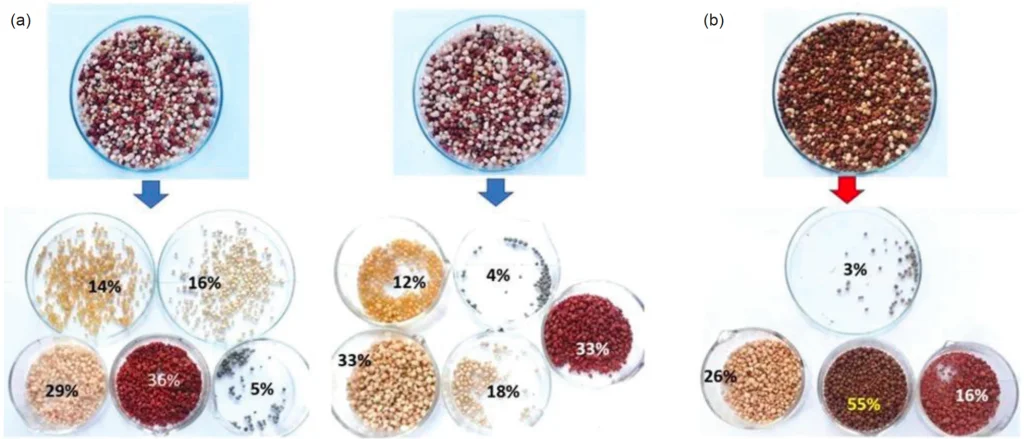
The research results showed that fertilizer quality can be grouped into three main categories, namely genuine fertilizer or specification-compliant, adulterated fertilizer, and counterfeit fertilizer. Genuine fertilizer has nutrient content that matches the label and standards. Adulterated fertilizer has nutrient content that is much lower, around 50% of the standard or label claim. Meanwhile, counterfeit fertilizer has nutrient content that deviates significantly from the label, and can even be below 1% for certain elements.
From a total of 723 samples analyzed, fertilizers not meeting specifications reached 2.8%. NPK fertilizer had the highest percentage of non-compliance at 2.4%, followed by kieserite at 0.3% and MgSB at 0.1%. This finding indicates that NPK fertilizer is one of the types most vulnerable to counterfeiting or adulteration, particularly because of its relatively high price, widespread use, and physical form that is easier to replicate.
In one case of NPK 10/6/24/5+0.96 B fertilizer, the nutrient content was found to be far below standard. The N content was only around 4.0%, P₂O₅ around 2.4%, and K₂O around 10.7%, whereas these values should be much higher according to the standard and label information. This non-compliance shows that laboratory examination remains an important step to ensure fertilizer quality, especially for fertilizers used on plantation scales.
This research also showed that visual inspection alone is not always sufficient to distinguish genuine fertilizers from specification-noncompliant fertilizers. Some counterfeit or adulterated fertilizers can have appearances similar to genuine fertilizers. However, in some cases, genuine NPK fertilizer tends to have richer variation in granule color, including white and yellowish colors, while adulterated or counterfeit fertilizers tend to have more dominant dark brown granules and less diverse color composition.
Collaboration and Support:
This research was conducted through collaboration between Smart Agriculture Research Center, Department of Agricultural Engineering and Biosystems, Faculty of Agricultural Technology, Universitas Gadjah Mada; Department of Agribusiness, Faculty of Agriculture, Darwan Ali University; Department of Agro-Environmental Sciences, Faculty of Agriculture, Kyushu University, Japan; Wilmar International Plantation Region Central Kalimantan; and Department of Agrotechnology, Faculty of Agriculture, STIPER Agricultural Institute Yogyakarta.
This collaboration brought together expertise in precision agriculture, oil palm fertilizer management, fertilizer nutrient content analysis, soil science, agribusiness, plantation technology, and agricultural input quality evaluation. Support from plantation partners also enabled this research to obtain a true picture of fertilizer use in the field, including sampling procedures, fertilizer conditions upon receipt, and challenges in detecting specification-noncompliant fertilizers.
This research received support from the Directorate of Research Universitas Gadjah Mada and the UGM Reputation Enhancement Team Towards World-Class University through the Post-Doctoral Program research scheme No. 3662/UN1.P.II/Dit-Lit/PT.01.03/2023. The research team also expressed appreciation to the Smart Agriculture Research Group, Department of Agricultural Engineering and Biosystems, Universitas Gadjah Mada, and Wilmar International Plantation Region Central Kalimantan for support of facilities, data, and field research implementation.
Benefits and Impact:
This research provides important contributions to more transparent and data-based fertilizer management in oil palm plantations. By knowing the quality and nutrient content of fertilizers more accurately, farmers and plantation managers can make better decisions before fertilizers are applied to their land.
These findings also help increase vigilance against specification-noncompliant fertilizers. The use of counterfeit or adulterated fertilizers can prevent plants from obtaining sufficient nutrients, reduce productivity, damage soil health, and cause economic losses. Therefore, a fertilizer quality verification system becomes important to support productivity and sustainability of the oil palm industry.
This research also drives the need for strengthened fertilizer quality inspection, whether through laboratory testing, more targeted visual inspection, or development of rapid detection technology in the field. With improved surveillance systems, the risk of counterfeit fertilizer use can be reduced, so that fertilization costs can be utilized more effectively.
From the Sustainable Development Goals (SDGs) perspective, this research supports SDG 2: Zero Hunger because it contributes to increased productivity and sustainability of agricultural production systems. This research is also aligned with SDG 8: Decent Work and Economic Growth, because it helps reduce economic losses from the use of substandard fertilizers. Additionally, strengthened fertilizer quality evaluation supports SDG 9: Industry, Innovation, and Infrastructure through the development of evaluation and monitoring systems for agricultural inputs. In the long term, this research also contributes to SDG 12: Responsible Consumption and Production and SDG 15: Life on Land, because it encourages more responsible fertilizer use, maintains soil health, and supports more sustainable plantation practices.
Going forward, the results of this research can serve as a basis for developing rapid fertilizer quality detection systems in the field, a commercial fertilizer quality database, and digital-based fertilizer tracking and verification systems. Integration between laboratory analysis, nutrient sensors, reporting systems, and precision agriculture platforms can strengthen fertilizer quality monitoring and help farmers and plantation managers make safer, more efficient, and more sustainable fertilization decisions.
The complete publication of this research can be accessed through the following DOI link: https://doi.org/10.21894/jopr.2024.0043
Contact: Lilik Sutiarso lilik-soetiarso@ugm.ac.id
Originally published on our previous site. Read the original