
Publication
Research Publication: Multispectral Drone for Faster and More Precise Monitoring of Papaya Plant Health
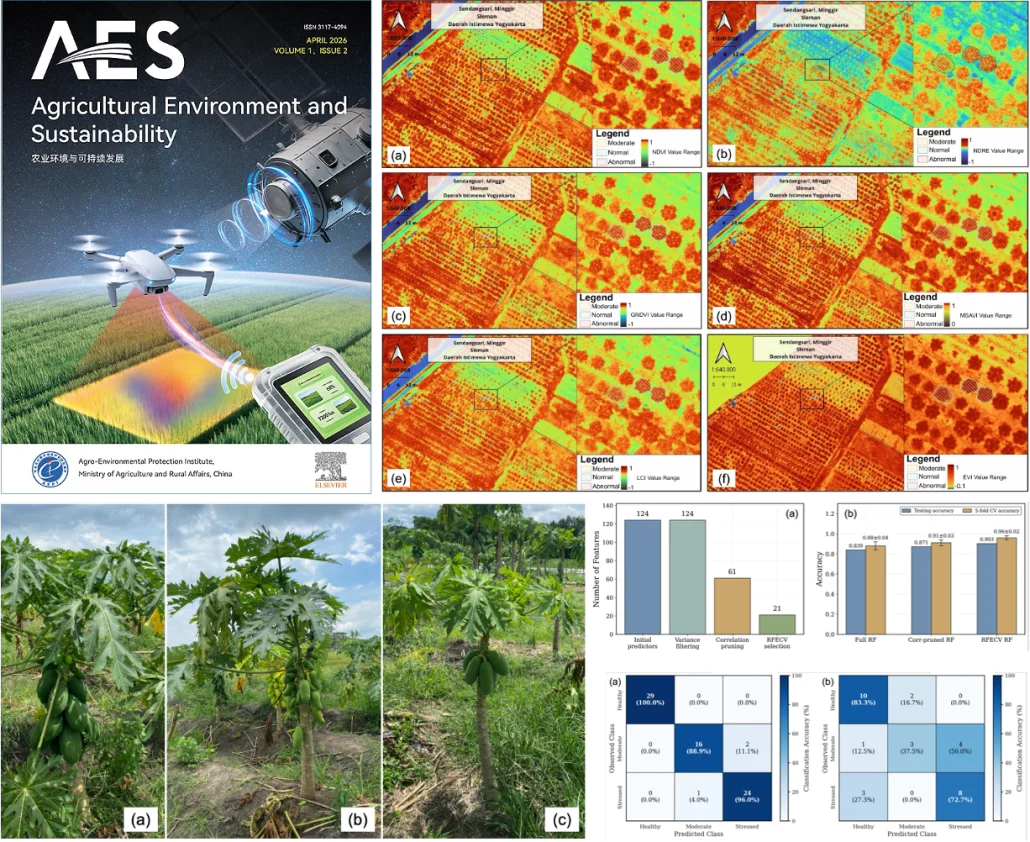
Yogyakarta, May 15, 2026 – Smart Agriculture Research Center Universitas Gadjah Mada has produced another research publication in the international journal Agricultural Environment and Sustainability published by Elsevier. This research develops an approach for monitoring papaya plant health using multispectral UAV-VTOL imagery and Artificial Intelligence (AI) analysis.
Papaya is one of the important tropical horticultural commodities; however, its health condition can vary across a single field. These differences can be influenced by water availability, nutrient content, soil conditions, and microenvironments surrounding the plants. To date, plant health monitoring has often been conducted through visual observation or direct field measurements, which require considerable time and labor.
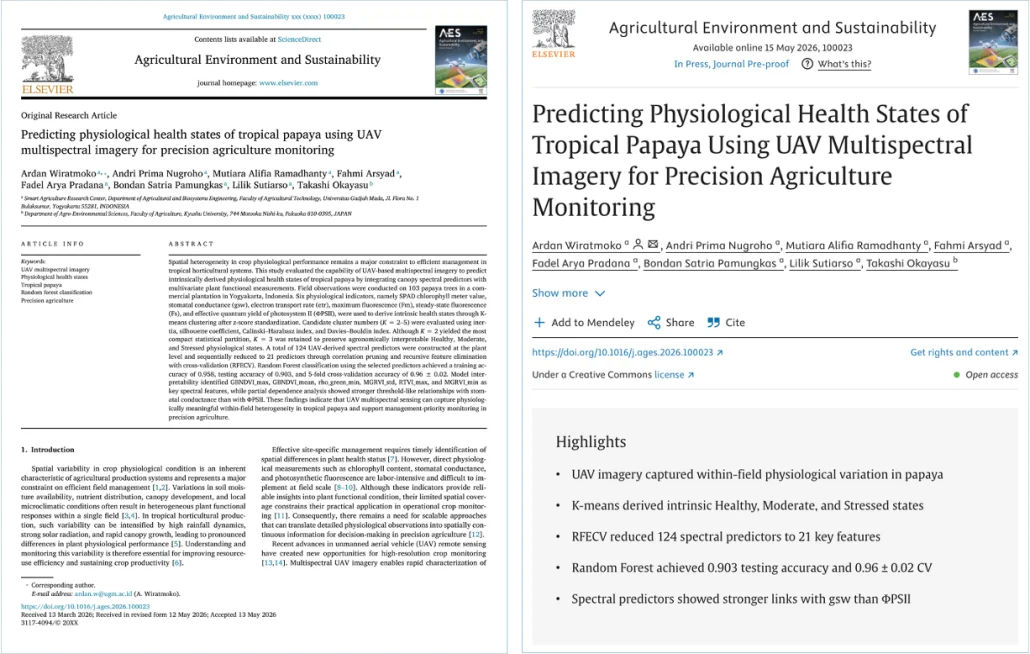
The research entitled "Predicting Physiological Health States of Tropical Papaya Using UAV Multispectral Imagery for Precision Agriculture Monitoring" was conducted by Ardan Wiratmoko, Andri Prima Nugroho, Mutiara Alifia Ramadhanty, Fahmi Arsyad, Fadel Arya Pradana, Bondan Satria Pamungkas, Lilik Sutiarso, and Takashi Okayasu. The article has been available online since May 15, 2026 with article number 100023.
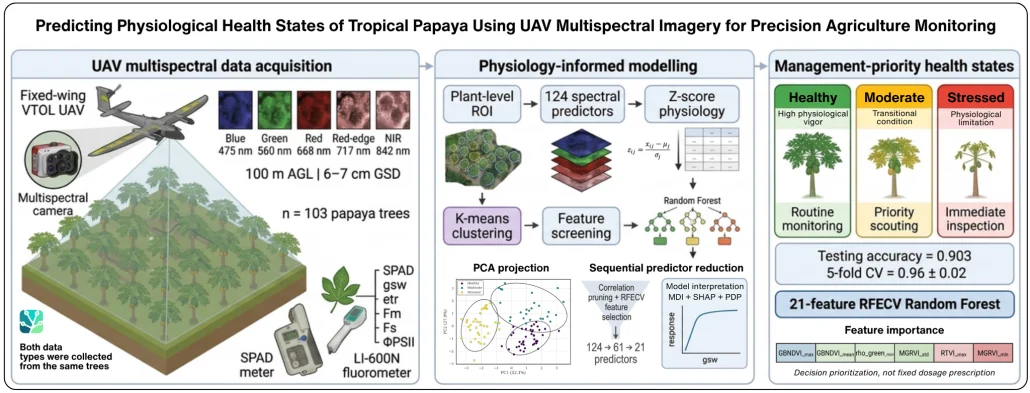
The research was conducted on 103 papaya trees in a commercial plantation in Yogyakarta. The research team used a VTOL drone equipped with a multispectral sensor to record the plant canopy conditions from the air. At the same time, physiological measurements of plants were also conducted in the field, such as chlorophyll content, stomatal activity, and plant photosynthesis indicators.
Through data analysis, the health condition of papaya plants was classified into three categories: Healthy, Moderate, and Stressed. These three categories were not determined solely by the visual appearance of plants, but based on a combination of plant physiological data. Thus, this system can help recognize plant conditions in a more objective and data-driven manner.
Drone data was then analyzed using a Random Forest model to predict plant health categories. From 124 spectral features generated from drone imagery, the model filtered important features down to 21 main features. As a result, the model achieved a test accuracy of 90.3% and cross-validation accuracy of 0.96 ± 0.02.
Collaboration and Support:
This research was conducted through collaboration between Smart Agriculture Research Center, Department of Agricultural and Biosystems Engineering, Faculty of Agricultural Technology, Universitas Gadjah Mada, and the Department of Agro-Environmental Sciences, Kyushu University, Japan. This collaboration brought together expertise in precision agriculture, UAV-based remote sensing, plant physiology, data analysis, and plant monitoring decision support systems for tropical horticultural crops.
This research also received funding support from the Faculty of Agricultural Technology, Universitas Gadjah Mada through the FTP Innovative Research Grant Batch 1 Year 2025. Smart Agriculture Research Center UGM provided technical support in field data acquisition activities and UAV operations, while the Inter-University Excellence Center (PUAPT) UGM WGFS 1.2 Precision Agriculture and Smart Farming supported access to research facilities. The research team also extends appreciation to Samuel Gatot Marseno, Hafidz Ebril Perdana, and Lukas Wiku Kuswidiyanto for their assistance in field measurements and data collection.
Benefits and Impact:
This research demonstrates that multispectral drones can be an effective tool for monitoring papaya plant health in a faster, broader, and more precise manner. This technology has the potential to help farmers, plantation managers, and researchers identify plant areas that require early attention, so that field observation activities can be conducted in a more targeted manner.
With this approach, plants in healthy condition can be monitored routinely, plants in moderate condition can be prioritized for field inspection, while plants showing signs of stress can be examined further immediately. This information can support decision-making regarding irrigation, fertilization, and land management in a more appropriate manner.
From a sustainability perspective, this research aligns with several Sustainable Development Goals (SDGs). More precise plant health monitoring can support SDG 2: Zero Hunger through improved productivity and resilience of food production systems. The use of UAVs, multispectral sensors, and Artificial Intelligence also supports SDG 9: Industry, Innovation, and Infrastructure through the development of agricultural technology innovations. Furthermore, the use of data for more appropriate irrigation and fertilization management also supports SDG 12: Responsible Consumption and Production, as it can help reduce wastage of resources and agricultural inputs. In the long term, this data-driven plant monitoring system also contributes to SDG 13: Climate Action, particularly in helping farmers adapt to changing environmental and climatic conditions.
Going forward, this technology has the potential to be developed as part of a precision agriculture system for tropical horticulture. Integration of UAV-VTOL, multispectral sensors, physiological measurements, and artificial intelligence can help improve the efficiency of plantation management, reduce delays in detecting plant stress, and support more sustainable agricultural production.
The complete publication of this research can be accessed through the following DOI link: https://doi.org/10.1016/j.ages.2026.100023
Contact: Ardan Wiratmoko, S.T.P., M.Sc. ardan.w@ugm.ac.id
Originally published on our previous site. Read the original