
Publication
Research Publication: Simulation of Soil Moisture Monitoring System and Automatic Irrigation Control to Support Precision Agriculture
Yogyakarta, May 18, 2026 – Smart Agriculture Research Center Universitas Gadjah Mada has produced another research publication in Jurnal Pertanian Presisi. This research develops a simulation of a soil moisture monitoring system based on Analog to Digital Converter (ADC) and automatic irrigation control using the hysteresis method to support precision agriculture applications.
Soil water availability is an important factor in plant growth and water use efficiency. In conventional cultivation practices, irrigation is still often carried out based on fixed schedules or visual observation. This approach risks causing improper water application, either too little or excessive. Therefore, a soil moisture monitoring system is needed that can provide more measurable information as a basis for irrigation decision-making.
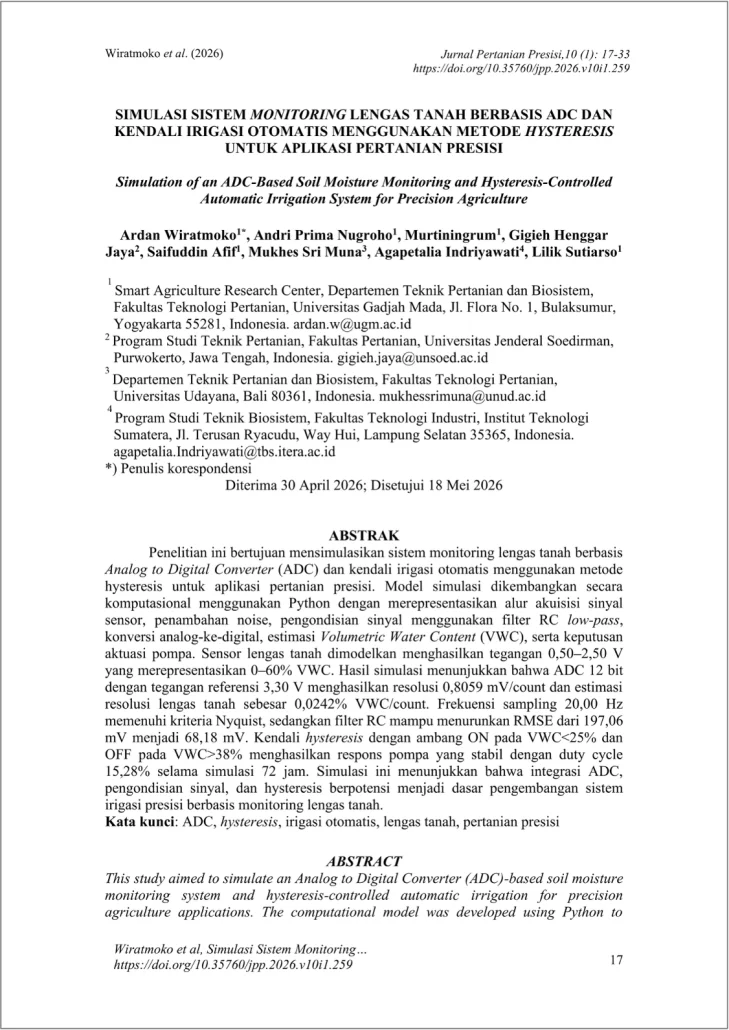
The research titled "Simulation of Soil Moisture Monitoring System Based on ADC and Automatic Irrigation Control Using Hysteresis Method for Precision Agriculture Applications" was conducted by Ardan Wiratmoko, Andri Prima Nugroho, Murtiningrum, Gigieh Henggar Jaya, Saifuddin Afif, Mukhes Sri Muna, Agapetalia Indriyawati, and Lilik Sutiarso. The article has been published in Jurnal Pertanian Presisi Volume 10 Number 1 Year 2026 on pages 17–33.
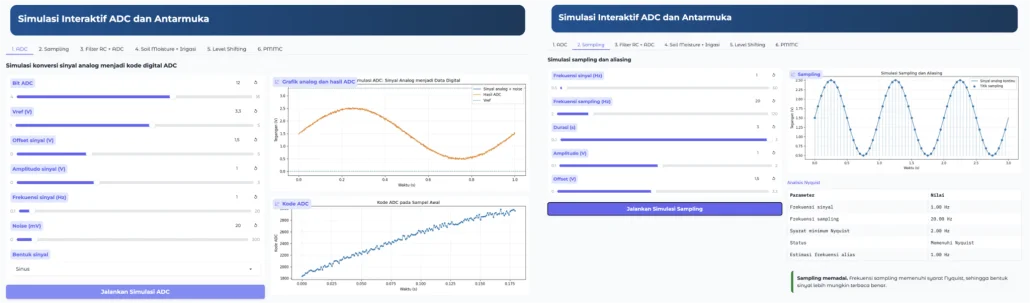
Unlike research that directly focuses on hardware development, this research first employs a computational simulation approach. The simulation is conducted to understand how signals from a soil moisture sensor are read, subjected to disturbance or noise, processed using a filter, converted into digital data through ADC, and then used as the basis for deciding whether to activate or deactivate the irrigation pump.
Simply put, the system simulates a soil moisture sensor that generates analog voltage to represent soil water content or Volumetric Water Content (VWC). This analog data is then converted into digital data using a 12-bit ADC. After that, the system estimates the soil moisture value and determines when the pump needs to turn on or off using the hysteresis method.
The hysteresis method works with two thresholds. The pump turns on when the VWC value is below 25%, and turns off when the VWC value is above 38%. With these two limits, the pump does not easily turn on and off repeatedly when the sensor reading fluctuates around a single threshold value. This approach makes the irrigation system more stable.
The simulation results show that a 12-bit ADC with a reference voltage of 3.30 V is able to produce a reading resolution of 0.8059 mV/count, with an estimated soil moisture resolution of 0.0242% VWC/count. A sampling frequency of 20 Hz also meets the Nyquist criteria, so the sensor signal can be well represented in digital form.
Furthermore, the use of a low-pass RC filter proved capable of improving signal quality. The signal RMSE decreased from 197.06 mV to 68.18 mV after undergoing the filtering process. This result demonstrates that the quality of sensor reading is not only determined by ADC resolution, but also by signal stability before entering the digital system.
In the 72-hour irrigation simulation, the hysteresis control system produced stable pump response. The pump was active for 11 hours with a duty cycle of 15.28%. This shows that the pump only operates when soil moisture conditions require water replenishment, not based on a fixed schedule. Thus, this system has the potential to become the foundation for developing more efficient, data-based automatic irrigation.
Collaboration and Support:
This research was conducted through collaboration between Smart Agriculture Research Center, Department of Agricultural and Biosystems Engineering, Faculty of Agricultural Technology, Universitas Gadjah Mada; Program of Agricultural Engineering, Faculty of Agriculture, Universitas Jenderal Soedirman; Department of Agricultural and Biosystems Engineering, Faculty of Agricultural Technology, Universitas Udayana; and Program of Biosystems Engineering, Faculty of Industrial Technology, Institut Teknologi Sumatera.
This collaboration brought together expertise in precision agriculture, agricultural instrumentation, soil moisture monitoring systems, computational simulation, automatic irrigation control, and sensor-based system development. Through this collaboration, the research not only addresses irrigation from an agronomic perspective, but also emphasizes the importance of sensor data quality, analog-to-digital conversion, signal conditioning, and control logic in the development of smart irrigation systems.
The research team expressed appreciation to the Working Group Food Security (WGFS 1.2) Precision Agriculture and Smart Farming, Inter-University Center of Excellence (PUAPT) Universitas Gadjah Mada, for support of research facilities. The research team also thanks Smart Agriculture Research Center, Department of Agricultural and Biosystems Engineering, Faculty of Agricultural Technology, Universitas Gadjah Mada, for technical support, research collaboration, academic mentoring, and an academic environment that supported the implementation of this research.
Benefits and Impact:
This research provides an important contribution to the development of precision irrigation systems based on soil moisture monitoring. Through this simulation, system design can be evaluated before being developed into hardware and tested in the field. This approach can help reduce the risk of design errors, clarify the technical requirements of the system, and accelerate the development process of automatic irrigation technology.
The simulated system has the potential to assist farmers, researchers, and agricultural technology developers in understanding when irrigation needs to be performed based on actual soil moisture conditions. With a sensor-based and automatic control approach, water application can be directed to better match plant needs, rather than simply following a fixed schedule.
From the perspective of Sustainable Development Goals (SDGs), this research supports SDG 2: Zero Hunger as it contributes to the development of precision agriculture technology to support plant productivity. This research is also aligned with SDG 6: Clean Water and Sanitation through the potential for water use efficiency in irrigation systems. Additionally, the development of simulation-based ADC, sensors, and automatic control supports SDG 9: Industry, Innovation, and Infrastructure through innovation in technology for smart agriculture. In the long term, data-based irrigation systems also support SDG 12: Responsible Consumption and Production and SDG 13: Climate Action, as they help promote more efficient, adaptive, and sustainable use of water resources.
Going forward, this research can be further developed through validation using actual soil moisture sensors in the field, testing on various soil types and environmental conditions, and hardware implementation involving sensors, ADC, filters, protection circuits, and irrigation pump actuators. The hysteresis method can also be compared with other control strategies, such as fuzzy logic, evapotranspiration-based control, or model predictive control, so that the automatic irrigation system becomes more adaptive and ready for application in precision agriculture.
The full publication of this research can be accessed through the following DOI link: https://doi.org/10.35760/jpp.2026.v10i1.259
Contact: Ardan Wiratmoko, S.T.P., M.Sc. ardan.w@ugm.ac.id
Originally published on our previous site. Read the original