
Publication
Research Publication: Intelligent System for Rapid Fertilizer Quality Checking in the Field
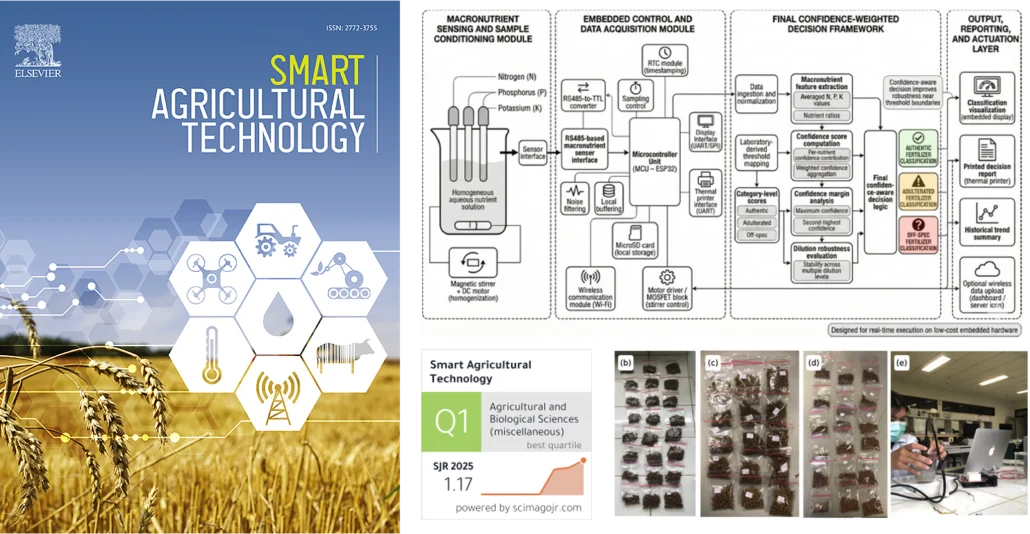
Yogyakarta, 13 April 2026 – Smart Agriculture Research Center Universitas Gadjah Mada proudly announces the publication of research in the prestigious international journal Smart Agricultural Technology (Q1) published by Elsevier. This research develops an intelligent system to help check fertilizer quality rapidly in the field using low-cost macronutrient sensors.
Fertilizer quality is one of the important factors in the success of agricultural cultivation. Fertilizer with nutrient content that does not meet specifications can result in ineffective fertilization, reduced crop yields, and increased risk of cost wastage and environmental impact. To date, fertilizer quality checking is generally conducted through laboratory testing. Although accurate, this process requires time, cost, and sample delivery procedures that are not always practical for rapid needs in the field or plantations.
The research titled "A confidence-weighted decision framework for on-site fertilizer quality screening and off-spec detection in smart agricultural systems using low-cost macronutrient sensors" was conducted by Andri Prima Nugroho, Ardan Wiratmoko, Ulfa Dwi Oktasari, Ririn Febri Kusumawardani, Fadel Arya Pradana, Lilik Sutiarso, Sukarman, Suwardi, Septa Primananda, and Takashi Okayasu. The article has been published in Smart Agricultural Technology Volume 14 Year 2026 with article number 102103.
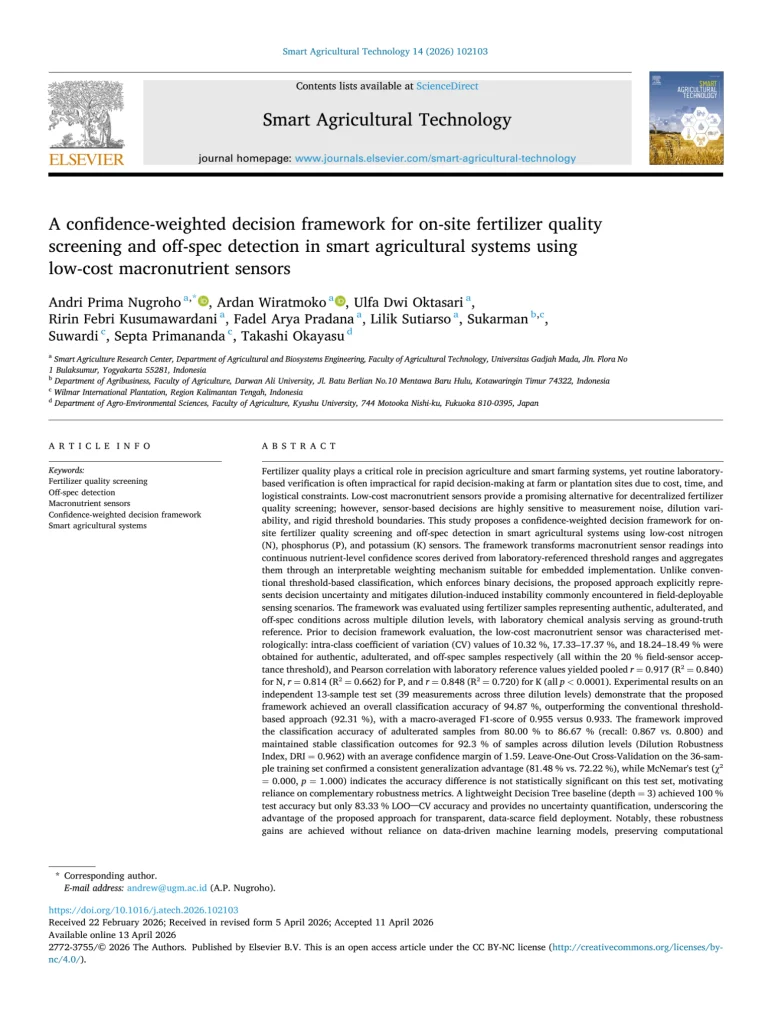
The developed system uses sensors to read the content of major nutrient elements in fertilizer, namely nitrogen (N), phosphorus (P), and potassium (K). Data from the sensors is then analyzed using a confidence-weighted decision framework. Simply put, this system does not only provide "compliant" or "non-compliant" results, but also considers the confidence level of each measurement result. This approach is important because sensor readings in the field can be influenced by sample variation, dilution, and measurement conditions.
In this research, fertilizer was tested in several categories: original fertilizer, mixed or adulterated fertilizer, and off-specification fertilizer. The test results show that the system is capable of classifying fertilizer quality with an accuracy of 94.87%, higher compared to the conventional threshold method of 92.31%. The system is also able to maintain consistency of results at various sample dilution levels, making it more suitable for practical use in the field.
Collaboration and Support:
This research was conducted through collaboration between Smart Agriculture Research Center, Department of Agricultural and Biosystems Engineering, Faculty of Agricultural Technology, Universitas Gadjah Mada; Department of Agribusiness, Faculty of Agriculture, Darwan Ali University; Wilmar International Plantation Region Central Kalimantan; and Department of Agro-Environmental Sciences, Faculty of Agriculture, Kyushu University, Japan.
This collaboration brings together expertise in precision agriculture, sensor systems, macronutrient analysis, embedded systems, and the need for technology implementation at plantation and commercial agriculture scales. Through this collaboration, the research not only focuses on device and analysis method development, but is also directed to meet real needs in the field, particularly in checking fertilizer quality before application to land.
This research received funding support from the Directorate of Research and Community Service, Universitas Gadjah Mada through the Academic of Excellence Program B No. 684/UN1.P/KPT/HUKOR/2025. This research was also supported by the 2025 Innovation Development Grant Program through the Promoting Research and Innovation through Modern and Efficient Science and Technology Parks (PRIMESTeP) project, managed by the Directorate of Research and Development, Ministry of Higher Education, Science, and Technology of the Republic of Indonesia. The research team also expresses appreciation to the Working Group Food Security (WG.FS 1.2) Precision Agriculture and Smart Farming, PUAPT Universitas Gadjah Mada, for research facility support, and to Smart Agriculture Research Center, Department of Agricultural and Biosystems Engineering, Faculty of Agricultural Technology, Universitas Gadjah Mada, for technical and institutional support in conducting this research.
Benefits and Impact:
This research makes an important contribution to the development of smart agricultural systems, particularly to support fertilizer quality checking before application to land. With this system, farmers, plantation managers, and agricultural business practitioners can obtain preliminary information on fertilizer quality in a faster, easier, and more efficient manner.
The main advantage of this system is its ability to be used directly in the field without always depending on laboratory processes. The system is also designed to be computationally lightweight, making it potentially integrated with embedded devices, Internet of Things (IoT) systems, and other precision agriculture platforms.
This technology can help reduce the risk of using off-specification fertilizer, whether due to incorrect nutrient content, declining quality, or undesired mixing. With preliminary checking before fertilizer is used, fertilization decision-making can be conducted more carefully, transparently, and data-driven.
From the perspective of Sustainable Development Goals (SDGs), this research supports SDG 2: Zero Hunger because it contributes to improving the efficiency and reliability of agricultural inputs to support crop productivity. This system is also aligned with SDG 9: Industry, Innovation, and Infrastructure through the development of sensor innovations, embedded devices, and intelligent decision systems for agriculture. Additionally, fertilizer quality checking before application supports SDG 12: Responsible Consumption and Production, as it can help reduce fertilizer waste and the use of unsuitable inputs. In the long term, this technology also contributes to SDG 13: Climate Action, particularly through support for more efficient and measured fertilization practices with potential to reduce environmental burden from inappropriate fertilizer use.
Looking ahead, this technology has the potential to support more transparent fertilizer management, reduce the risk of using off-specification fertilizer, and help improve cost efficiency and sustainability of agricultural production. Further integration with digital platforms, reporting systems, and precision agriculture databases can strengthen the role of this technology as a decision-support tool at the farmer, plantation, and agricultural industry levels.
The complete publication of this research can be accessed through the following DOI link: https://doi.org/10.1016/j.atech.2026.102103
Contact: Andri Prima Nugroho, Ph.D. andrew@ugm.ac.id
Originally published on our previous site. Read the original