
Publication
Research Publication: Low-cost Thermal Camera-based Water Stress Monitoring System for Plants in Indoor Agriculture
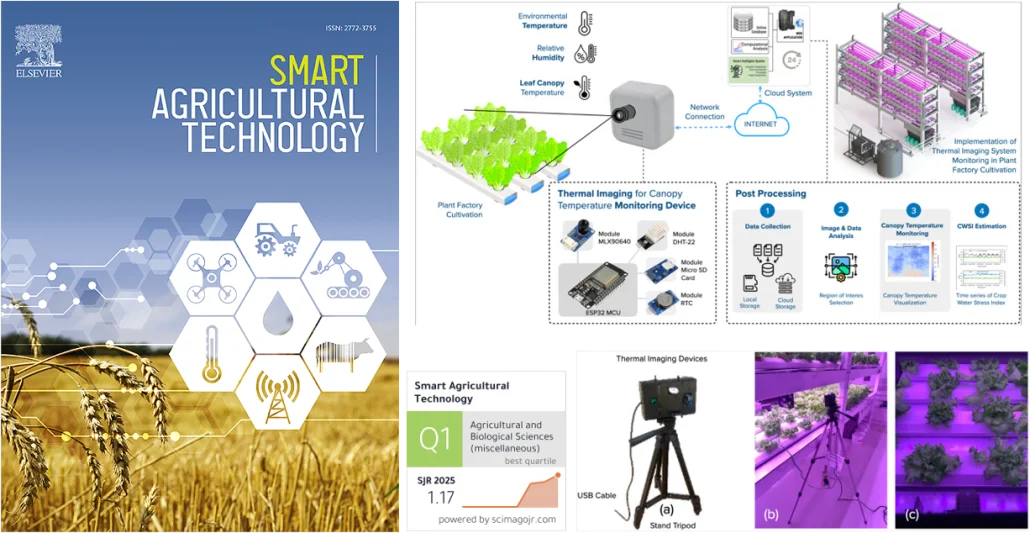
Yogyakarta, May 28, 2025 – Smart Agriculture Research Center of Universitas Gadjah Mada has produced another research publication in the prestigious international journal Smart Agricultural Technology (Q1) published by Elsevier. This research develops a cost-friendly thermal camera system to help monitor plant conditions in indoor agriculture, particularly in detecting water stress symptoms.
Indoor agriculture is increasingly being developed because it can provide a more controlled growing environment. However, water management remains an important challenge. Plants lacking water can experience growth disorders, but symptoms are often difficult to recognize early if only observed visually. Therefore, a monitoring system that is faster, more practical, and non-destructive to plants is needed.
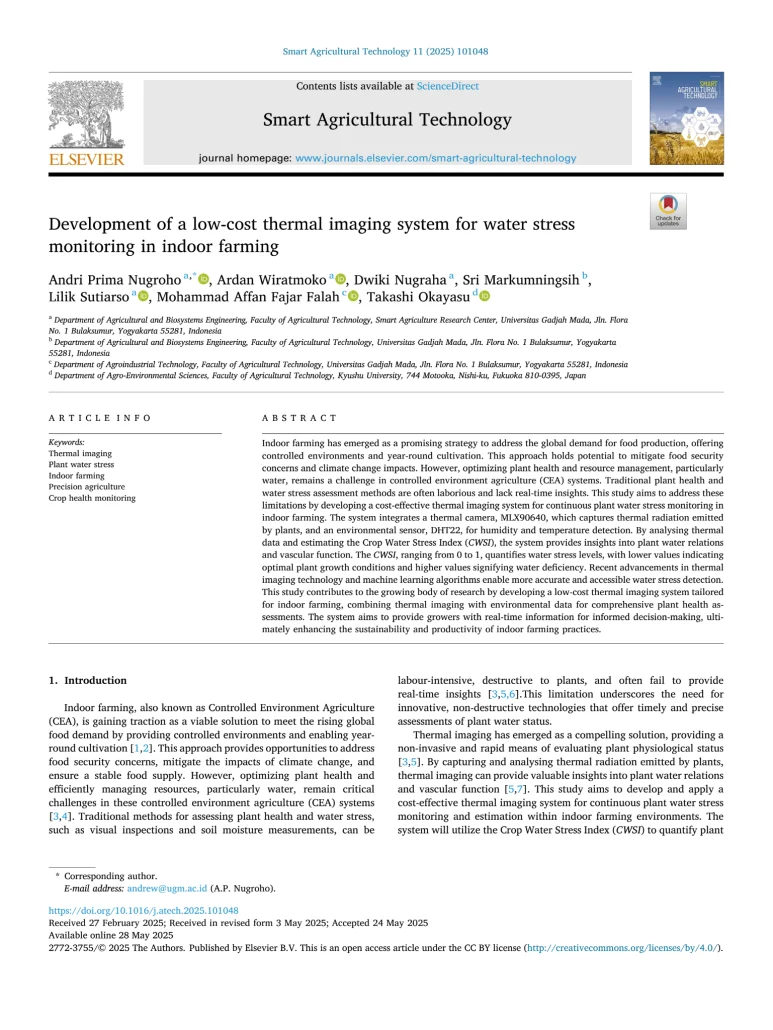
The research titled "Development of a low-cost thermal imaging system for water stress monitoring in indoor farming" was conducted by Andri Prima Nugroho, Ardan Wiratmoko, Dwiki Nugraha, Sri Markumningsih, Lilik Sutiarso, Mohammad Affan Fajar Falah, and Takashi Okayasu. The article has been published in Smart Agricultural Technology Volume 11 Year 2025 with article number 101048.
The system developed uses a thermal camera to read the surface temperature of plant leaves or canopy. This information is then combined with data on environmental temperature and humidity. Simply put, leaf temperature can be one of the important indicators of plant condition. When plants lack water, the evaporation process from leaves can be disrupted and canopy temperature tends to change. Through this system, such changes can be observed more objectively.
In this research, the system was tested in the SmartAgri Plant Factory environment. Data were collected automatically over several days to observe changes in plant temperature and environmental conditions in the cultivation space. The research results show that the system is capable of recording plant conditions periodically and producing temperature visualizations in the form of a heatmap. This visualization helps users see parts of plants or cultivation areas that have temperature differences.
System testing showed good results. The thermal camera used was able to provide measurement results close to the comparison instrument. Additionally, the system can also be used to estimate the level of plant water stress through the Crop Water Stress Index (CWSI) indicator. In observations of lettuce plants in the plant factory, most plant conditions were in the ideal to mild stress category. This indicates that the system can help monitor plant conditions in a more measurable manner.
Collaboration and Support:
This research was conducted through collaboration between the Smart Agriculture Research Center, Department of Agricultural and Biosystems Engineering, Faculty of Agricultural Technology, Universitas Gadjah Mada, with researchers from the Department of Agricultural and Biosystems Engineering, Department of Agricultural Industrial Technology, and the Department of Agro-Environmental Sciences, Kyushu University, Japan. This collaboration brings together expertise in precision agriculture, plant factory, thermal imaging, sensor systems, data analysis, and plant physiology.
In this research, the research team developed a cost-friendly thermal camera-based plant water stress monitoring system tested in the SmartAgri Plant Factory environment. Collaborative support from various fields enabled this system to be developed not only from the perspective of hardware and sensors, but also analyzed from the perspective of growing environmental conditions, plant responses, and the potential for its application in indoor agriculture systems.
This research received funding support from Universitas Gadjah Mada through the Academic Excellence B Scheme 2024 No. 6529/UN1.P1/PT.01.03/2024. The research team also expressed appreciation to PUAPT (Center of Excellence Among Universities) UGM for support of research facilities, and to Smart Agriculture Research Center UGM for technical support in conducting this research.
Benefits and Impact:
This research provides important contributions to the development of indoor agriculture and precision agriculture. This cost-friendly thermal camera system can be a helpful tool for farmers, plant factory managers, and researchers to learn about plant conditions earlier, especially regarding water requirements. With faster and more accurate information, adjustments to irrigation, temperature, humidity, and growing environment can be made more appropriately.
This technology also has the potential to help reduce water waste in cultivation systems. By recognizing early signs of water stress in plants, managers can provide water according to plant needs, not just based on a fixed schedule. This approach can support efficient use of resources and increase sustainability of plant production in controlled environments.
From the perspective of Sustainable Development Goals (SDGs), this research aligns with SDG 2: Zero Hunger because it supports the development of technology for more stable and efficient food production. This system also supports SDG 6: Clean Water and Sanitation through the potential for better water conservation and management in plant cultivation. Additionally, the use of thermal cameras, environmental sensors, and data-based monitoring systems supports SDG 9: Industry, Innovation, and Infrastructure through the development of agricultural technology innovation. In the long term, this technology also contributes to SDG 12: Responsible Consumption and Production and SDG 13: Climate Action, as it helps promote agricultural production that is more resource-efficient, adaptive, and sustainable.
Going forward, this system has the potential to be further developed with integration of Internet of Things (IoT), cloud-based data storage, and artificial intelligence analysis. Such development is expected to support more efficient indoor agriculture that is water-saving and capable of providing plant management recommendations in a more precise manner.
The complete publication of this research can be accessed through the following DOI link: https://doi.org/10.1016/j.atech.2025.101048
Contact: Andri Prima Nugroho, Ph.D. andrew@ugm.ac.id
Originally published on our previous site. Read the original