
Publication
Research Publication: Multidepth Soil Sensor System for Monitoring Root Zone Stability in Oil Palm Plantations
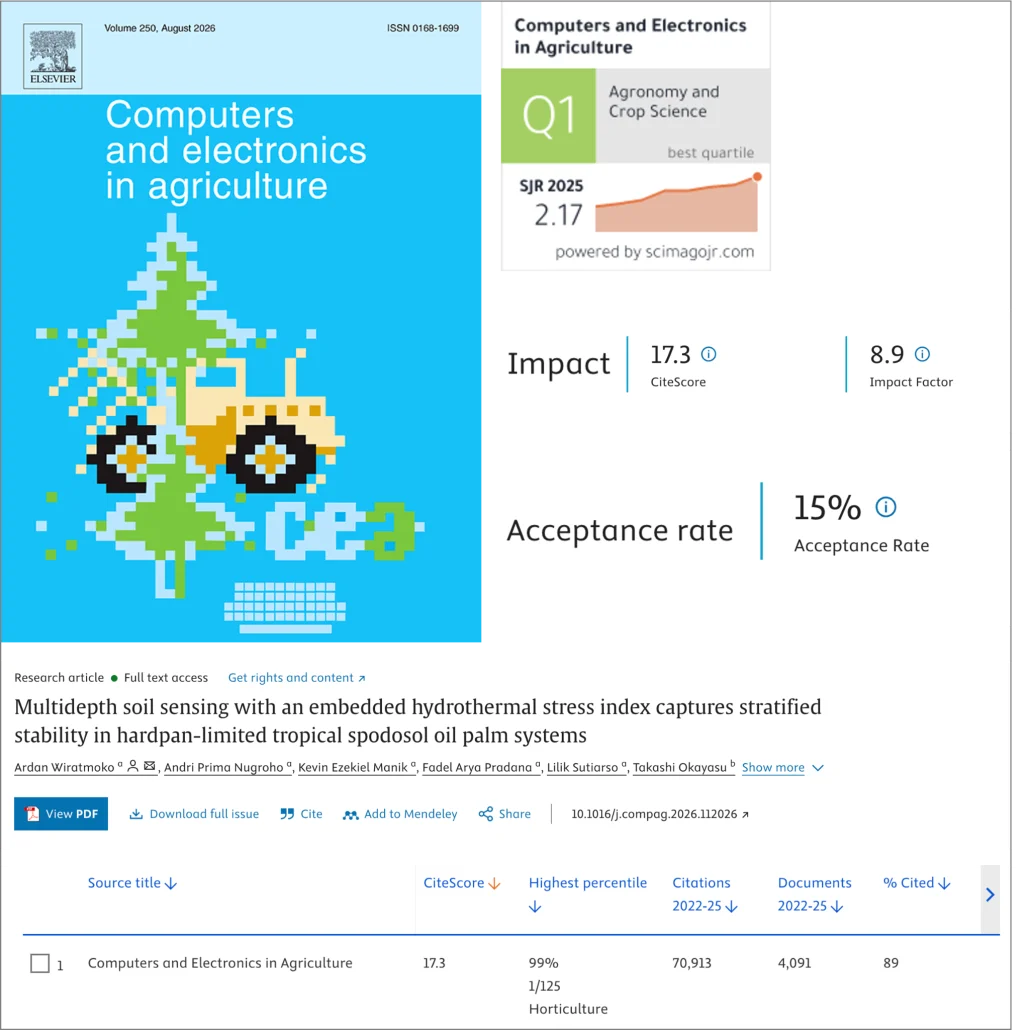
Yogyakarta, June 15, 2026 – Smart Agriculture Research Center Universitas Gadjah Mada has produced another research publication in the prestigious international journal Computers and Electronics in Agriculture (Q1) published by Elsevier. This research develops a multidepth soil monitoring system to measure soil moisture and soil temperature conditions on tropical oil palm plantations, particularly on Spodosol land that has a hardpan layer.
Oil palm plantations on tropical land often face challenges related to water availability in the root zone. On Spodosol land, the presence of a hardpan layer can limit water and plant root movement. This condition makes changes in soil water and temperature not always the same at each depth. Therefore, soil monitoring at a single depth alone is often insufficient to accurately describe the conditions in the root zone.
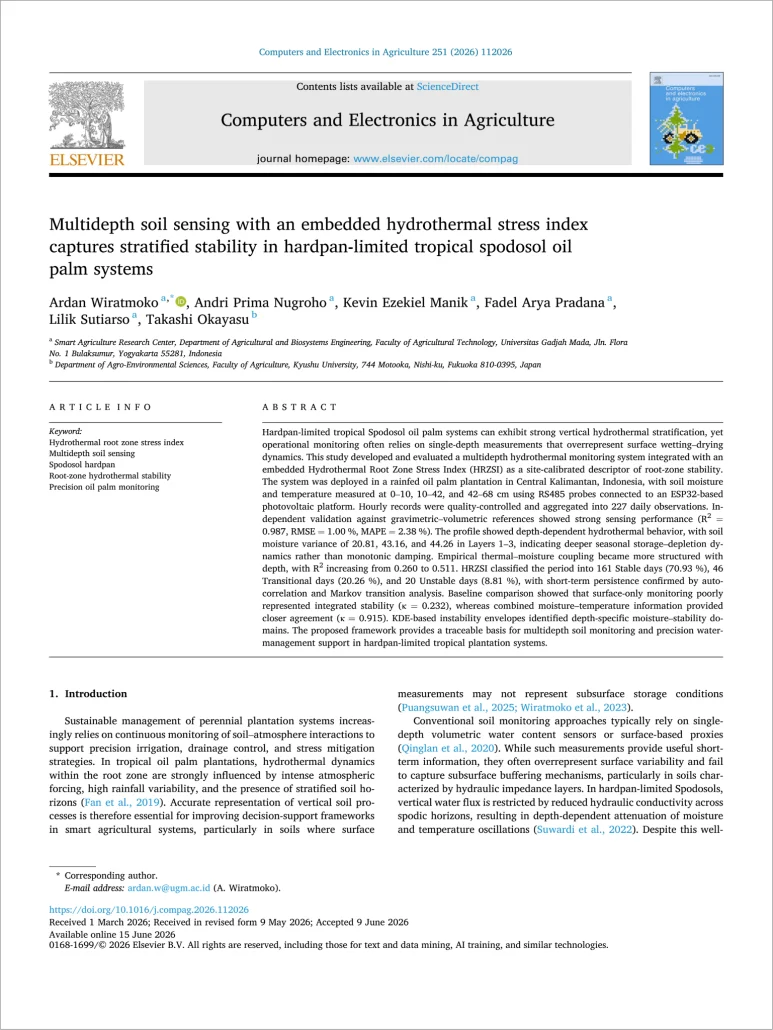
The research titled "Multidepth soil sensing with an embedded hydrothermal stress index captures stratified stability in hardpan-limited tropical spodosol oil palm systems" was conducted by Ardan Wiratmoko, Andri Prima Nugroho, Kevin Ezekiel Manik, Fadel Arya Pradana, Lilik Sutiarso, and Takashi Okayasu. The article has been published in Computers and Electronics in Agriculture Volume 251 Year 2026 with article number 112026.
The developed system uses soil sensors installed at three depths, namely 0–10 cm, 10–42 cm, and 42–68 cm. These three layers are used to represent surface soil conditions, middle layer, and deeper layer above the hardpan. The sensors periodically measure soil moisture and soil temperature, then transmit data through a system based on ESP32 microcontroller, RS485 communication, GSM/GPRS module, and supported by solar panels to operate independently in the field.
Simply put, this research does not just measure whether soil is wet or dry, but also examines how water and temperature conditions change at each soil depth. This information is then processed into an index called the Hydrothermal Root Zone Stress Index (HRZSI). This index is used to describe the stability level of the root zone based on a combination of soil moisture and soil temperature data from multiple depths.
The research was conducted at a rainfed oil palm plantation in Central Kalimantan. Data were collected continuously, then filtered and summarized into 227 daily data points. The developed sensor system was also validated using comparison methods, and the results showed very good performance with an R² value of 0.987, RMSE of 1.00%, and MAPE of 2.38%.
The research findings show that soil conditions at each depth have different characteristics. The surface layer responds more quickly to rainfall and weather changes, while deeper layers show more seasonal water storage and depletion patterns. This proves that monitoring at a single depth alone is insufficient to understand water conditions in the root zone of oil palm on Spodosol land.
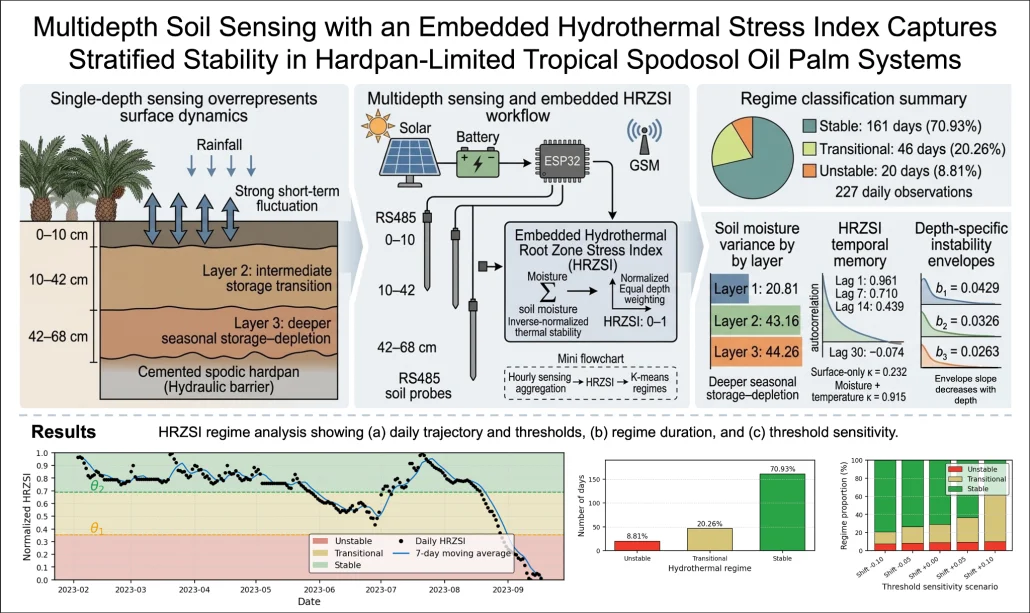
Through the HRZSI, the observation period can be grouped into three conditions: Stable, Transitional, and Unstable. Out of 227 observation days, 161 days or 70.93% fall into the Stable category, 46 days or 20.26% fall into the Transitional category, and 20 days or 8.81% fall into the Unstable category. This result shows that the system is capable of providing a more measurable picture of soil water and temperature stability in the root zone.
This research also demonstrates that monitoring based solely on surface soil is less able to represent the overall stability of the root zone. In contrast, a combination of data from multiple depths and soil temperature information provides a stronger and more accurate picture of actual conditions. Thus, this system can serve as a foundation for developing more precise soil monitoring for oil palm plantations.
Collaboration and Support:
This research was carried out through collaboration between Smart Agriculture Research Center, Department of Agricultural and Biosystems Engineering, Faculty of Agricultural Technology, Universitas Gadjah Mada, and the Department of Agro-Environmental Sciences, Faculty of Agriculture, Kyushu University, Japan. The research also received field implementation support from Wilmar International Plantation, Central Kalimantan Region, Indonesia.
This collaboration brings together expertise in precision agriculture, multidepth soil sensors, embedded systems, hydrothermal monitoring, data analysis, and oil palm plantation management on tropical land. Through this collaboration, the research not only focuses on sensor system development but is also directed to address actual needs in monitoring root zone conditions on Spodosol land that has physical soil limitations.
This research received funding support from Universitas Gadjah Mada through Academic Excellence C Scheme 2025 No. 5719/UN1.P2/Dit-Lit/PT.01.03/2025. The research team also expresses appreciation to the Working Group Food Security (WG.FS 1.2) Precision Agriculture and Smart Farming, Inter-University Excellence Center (PUAPT) Universitas Gadjah Mada, for research facility support, and to Smart Agriculture Research Center Universitas Gadjah Mada for technical and institutional support. Appreciation is also extended to Nada Berliana Kusumawati, Iqbal Maulana Haryadi, Muhdan Syarovy, Suwardi, Sukarman, and Septa Primananda for technical assistance in system development, field equipment installation, and data acquisition.
Benefits and Impact:
This research makes an important contribution to the development of soil monitoring systems on tropical oil palm plantations. With multidepth monitoring, plantation managers can obtain more complete information regarding root zone conditions, not just surface soil conditions. This information can help support decision-making related to irrigation, drainage, water management, and plant stress mitigation.
This system also has the potential to help plantation managers identify periods when the root zone is in stable, transitional, or unstable conditions. With this information, field actions can be taken more timely and data-driven. This approach is especially important on land with hardpan layers, since surface water conditions do not necessarily represent water conditions in deeper soil layers.
From the Sustainable Development Goals (SDGs) perspective, this research supports SDG 2: Zero Hunger as it contributes to technology development in support of agricultural system productivity and sustainability. This research also aligns with SDG 6: Clean Water and Sanitation through the potential for more efficient water management on plantation systems. Furthermore, the development of multidepth sensors, embedded systems, and hydrothermal indices supports SDG 9: Industry, Innovation, and Infrastructure through smart agriculture technology innovation. In the long term, this technology also contributes to SDG 12: Responsible Consumption and Production and SDG 13: Climate Action, as it can help promote more adaptive, efficient, and sustainable water and soil resource management.
Going forward, this system has the potential to be further developed through validation across various soil types, hardpan depths, drainage conditions, groundwater levels, canopy structures, and different plantation management zones. Further integration with Internet of Things (IoT) platforms, monitoring dashboards, early warning systems, and decision-making models can strengthen the role of this technology in supporting water management and hydrothermal stress monitoring on tropical oil palm plantations.
The complete research publication can be accessed through the following DOI link: https://doi.org/10.1016/j.compag.2026.112026
Contact: Ardan Wiratmoko, S.T.P., M.Sc. ardan.w@ugm.ac.id
Originally published on our previous site. Read the original