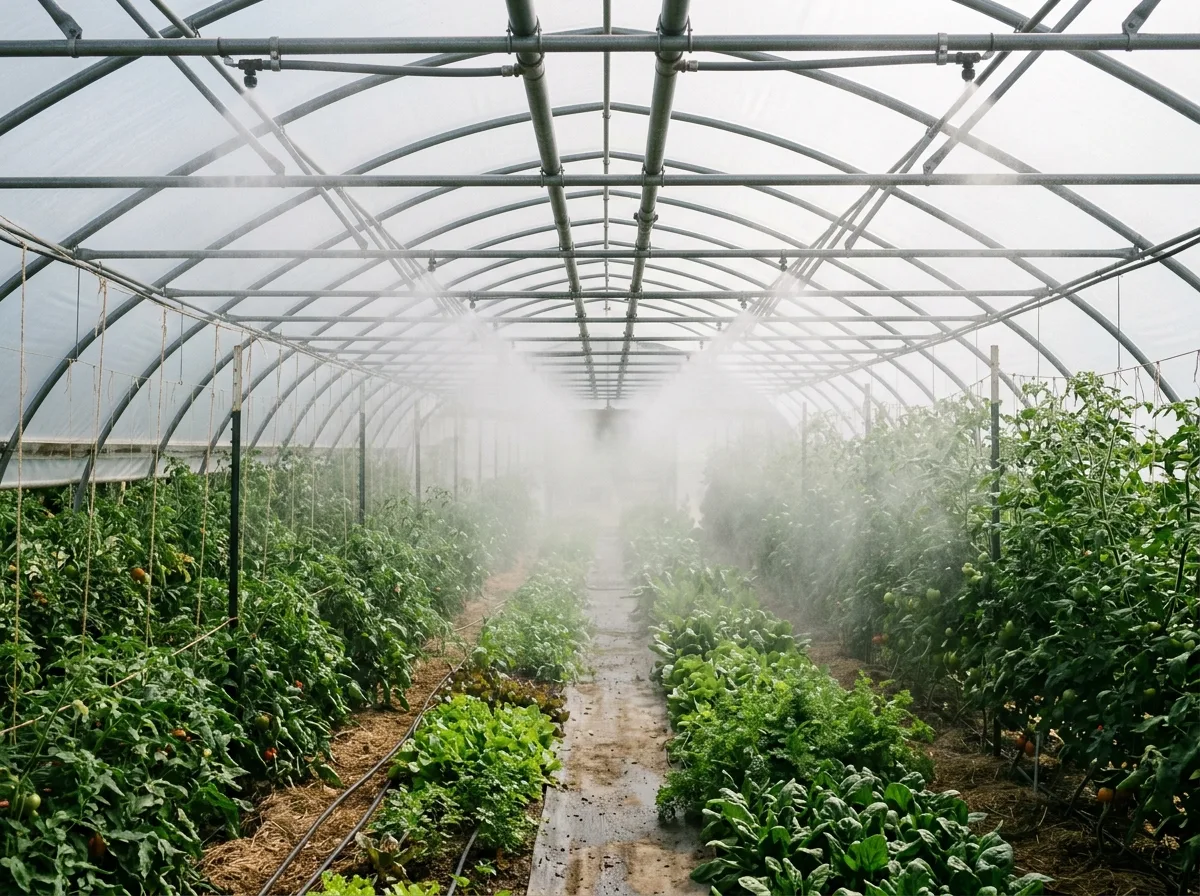
The goal is not a cool greenhouse, it is a crop that transpires steadily all day. That means managing heat, humidity, and carbon dioxide together.
Photo: heat, humidity, and air
Cooling
Solar load is the dominant challenge. The cheapest cooling is the heat you never let in, so screening and ventilation come before machinery.
Shade and diffuse screens to cut peak radiation load
Evaporative cooling where incoming air is dry enough to benefit
Mechanical cooling reserved for the hours that genuinely need it
Humidity control
High humidity stalls transpiration, and a crop that cannot transpire cannot take up calcium or shed heat. This is the defining tropical greenhouse problem.
Vapour pressure deficit as the actual control target
Air movement to break the boundary layer around leaves
Dehumidification and controlled air exchange where ventilation is not enough
Horticoolers and air treatment
Air handling units condition and distribute air where passive strategies run out, particularly in semi-closed houses and plant factories.
Conditioned air delivered evenly to the canopy rather than the roof space
Combined cooling and dehumidification in a single treatment step
Enclosed operation that keeps insects and pathogens out while managing climate
CO2 enrichment
In a well-sealed house, carbon dioxide becomes the limiting factor for photosynthesis long before light does. Enrichment only makes sense once the house holds it.
Measurement first, to establish whether depletion is actually occurring
Dosing balanced against the ventilation the climate demands
Most viable in semi-closed structures and plant factories