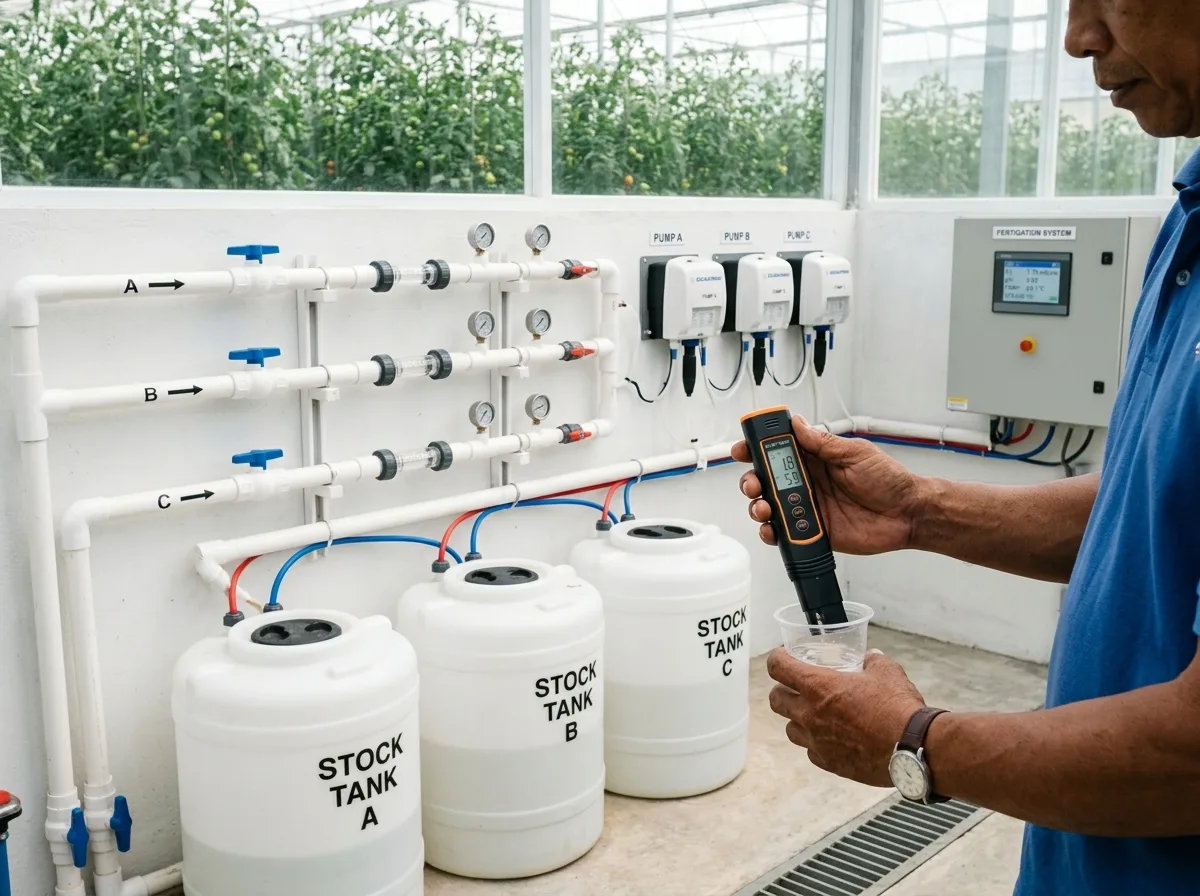
Pre-treatment
Source water decides the whole design. Iron, hardness, salinity, and pathogens all have to be dealt with before a nutrient recipe means anything.
- Full source water analysis as the starting point
- Filtration, iron removal, and softening as required
- Disinfection to keep pathogens out of the irrigation loop
Fertilization
A nutrient recipe is written for a specific crop, stage, and climate. It changes as the plant and the weather change.
- Recipes formulated from the source water analysis, not a generic table
- Adjustment by crop stage and by season
- Verification through solution and drain analysis
Dosing
The dosing unit is where the recipe becomes reality. Accuracy and reliability here show up directly in crop uniformity.
- Automated dosing controlled to target electrical conductivity and pH
- Multi-channel injection so elements can be steered independently
- Alarms and fail-safes, because a dosing fault is a fast crop loss
Post-treatment
Water that has passed the root zone carries nutrients and, potentially, pathogens. Treating it is what makes recirculation safe.
- Filtration to remove organic matter and particles
- Disinfection by ultraviolet, heat, or slow sand filtration
- Verification before the water rejoins the supply
Drainwater recycling
Recirculation is where controlled-environment growing earns its water reputation. It also stops fertiliser leaving the site as pollution.
- Drain collected, measured, and analysed rather than discarded
- Nutrients recovered and rebalanced back into the supply
- Sharply reduced water and fertiliser use per unit of production
Hydroponics and substrates
Growing without soil gives direct control of the root zone, and removes an entire category of soil-borne disease from the equation.
- Substrate culture on cocopeat or rockwool for fruiting crops
- Deep flow and nutrient film systems for leafy crops
- Root-zone moisture, temperature, and oxygen managed as control variables