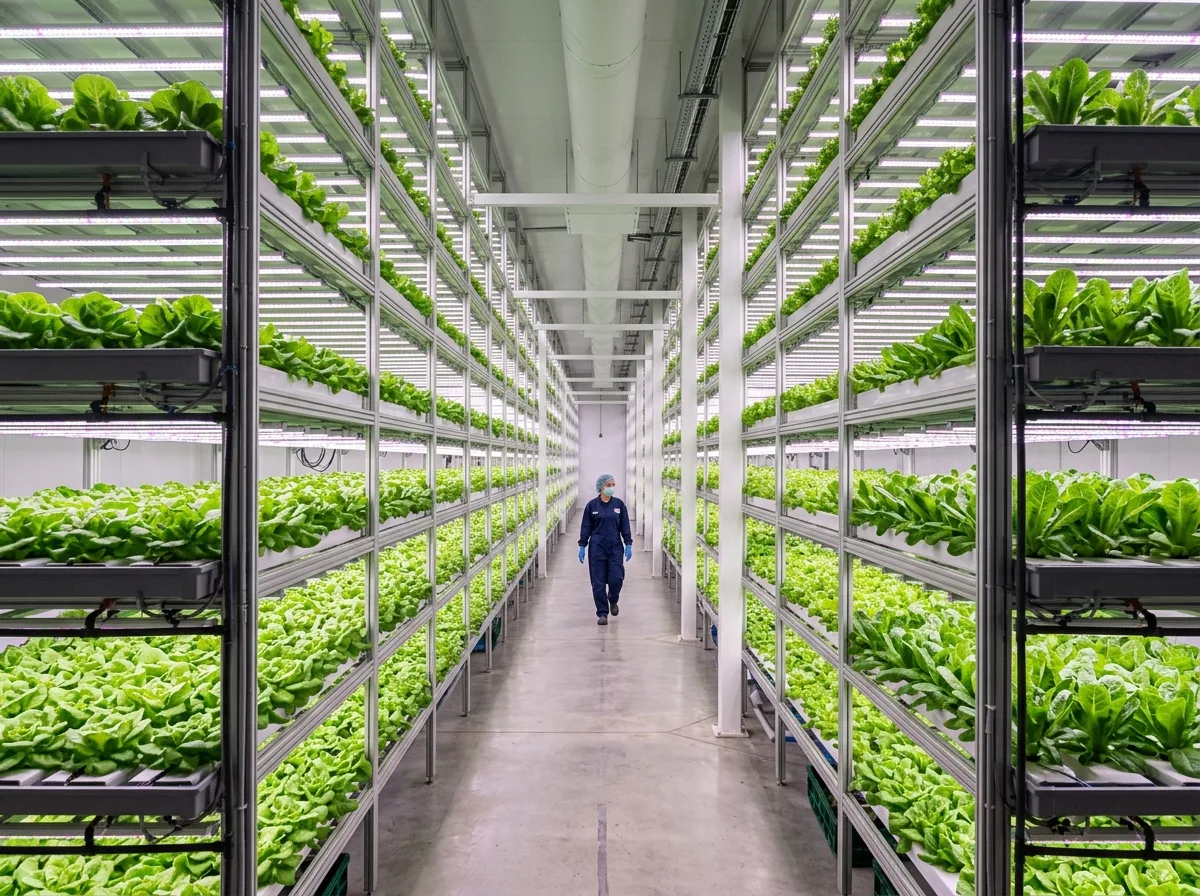
A plant factory removes the weather from the equation entirely. Every input is chosen: light spectrum and duration, temperature, humidity, carbon dioxide, and nutrition. What you gain in control, you pay for in energy.
Photo: closed plant factories
Stacked production
Growing in layers multiplies the output of a footprint, which is what makes production viable on expensive land close to the consumer.
Multiple growing layers within one building
Highest yield per square metre of any system
No dependence on land quality or drainage
Light recipes
With artificial light, the spectrum and photoperiod become adjustable inputs that shape yield, colour, texture, and flavour.
Spectrum tuned per crop and per growth stage
Photoperiod set to drive development on a schedule
Uniform light across every layer
Energy strategy
Energy is the deciding economic factor. A plant factory only works when the crop value and the energy plan are considered together from day one.
Lighting and cooling as the dominant loads
Heat from lighting recovered rather than simply rejected
Solar generation matched to the daytime load
Where it fits best
Plant factories reward short-cycle, high-value, compact crops. They are also an excellent research instrument.
Leafy greens, herbs, and microgreens
Seedling and transplant production at consistent quality
Research where every variable has to be held steady